Present Moment Awareness
Right now, your eyes scan these words. But where is your mind? Probably somewhere else. Replaying a conversation from yesterday. Rehearsing tomorrow's meeting. Scrolling through mental to-do lists. Your body is here, but you are not.
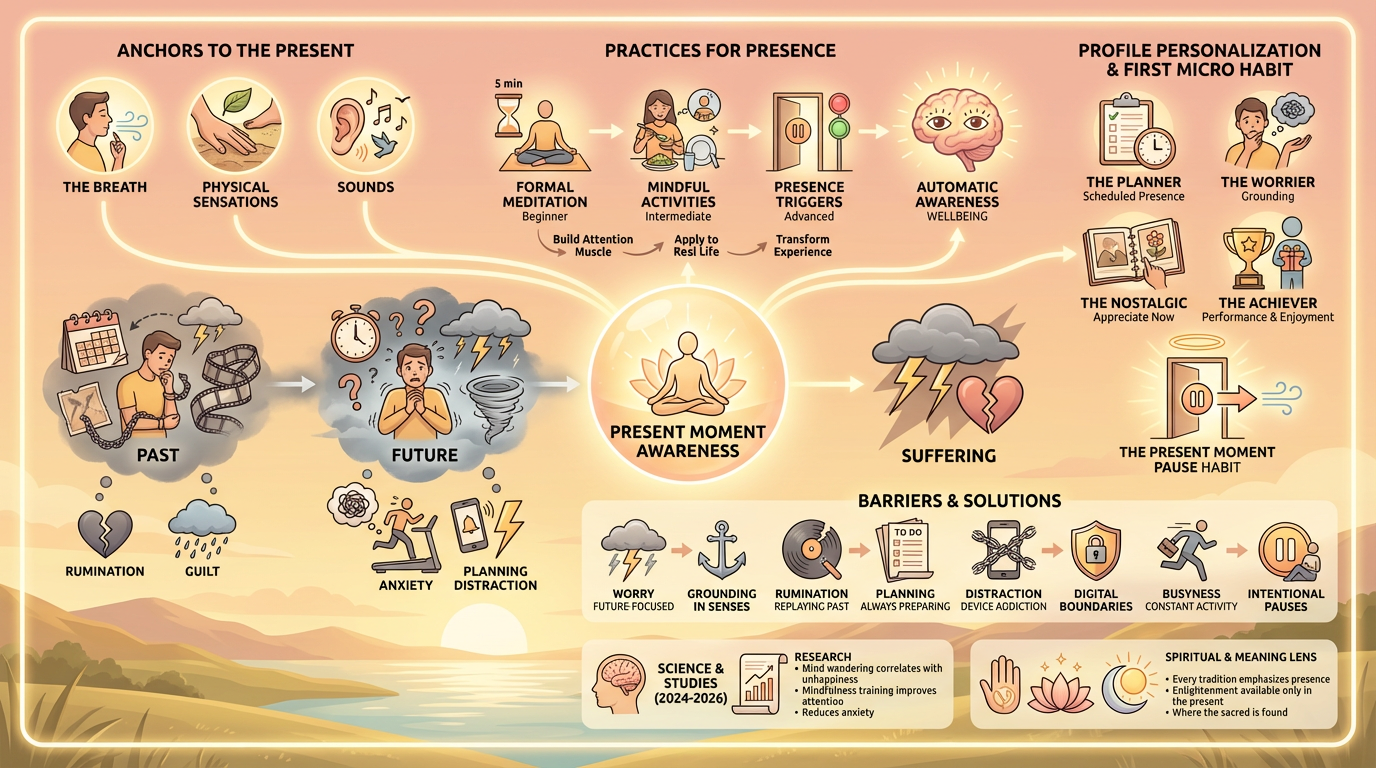
Harvard psychologists Matt Killingsworth and Daniel Gilbert built an app that pinged people randomly throughout the day asking what they were doing, what they were thinking about, and how happy they felt. The results from over fifteen thousand participants revealed something striking. Our minds wander 47% of our waking hours. And a wandering mind is an unhappy mind.
Present moment awareness is the skill of actually being where you are. It sounds simple because it is simple. But simplicity is not the same as easy. This guide covers the science of presence, the neuroscience of mind wandering, and practical techniques to bring you back to the only moment that exists. Later sections personalize the path for different personality types who struggle with presence in different ways.
Surprising Insight: Surprising Insight: Killingsworth's research found that what people were thinking about was a better predictor of happiness than what they were doing. Even pleasant mind wandering made people less happy than being present to a neutral activity.
The Science of Mind Wandering and Unhappiness
Not medical advice.
The Track Your Happiness study collected real-time data from thousands of people in eighty countries. Participants were randomly prompted throughout the day to report their current activity, whether their mind was wandering, what they were thinking about, and their current happiness level.
The findings challenged assumptions. Mind wandering occurred in 47% of all samples. It happened during every activity except making love. And regardless of what people were doing or thinking about, they reported being less happy when their minds were wandering than when focused on the present.
Most importantly, time-lag analysis showed that mind wandering preceded unhappiness rather than the reverse. People did not wander because they were already unhappy. They became unhappy because they wandered. This suggests mind wandering is a cause of unhappiness, not just a consequence.
The takeaway is clear: being present matters more for happiness than what activity you are doing. You can be happy washing dishes if fully present. You can be unhappy on vacation if mentally elsewhere.
Mind Wandering and Happiness
Harvard research findings on presence and wellbeing
🔍 Click to enlarge
Neuroscience of Presence: The Default Mode Network
Your brain has a network called the Default Mode Network (DMN) that activates when you are not focused on the external world. It is associated with mind wandering, self-referential thought, rumination about the past, and worry about the future.
During meditation and present moment awareness, brain imaging shows decreased activity in the DMN. This deactivation contributes to a heightened sense of presence and reduced anxiety. The wandering mind literally quiets down.
A 2024 systematic review found that Mindfulness-Based Stress Reduction enhances brain regions related to emotional processing and sensory perception. Routine mindfulness exercises create both structural and functional brain changes. MRI studies showed increased gray matter in the frontal lobe of meditators.
The 2025 Mount Sinai study using intracranial EEG found meditation changes activity in the amygdala and hippocampus, key regions for emotional regulation and memory. These changes in beta and gamma waves occurred even in first-time meditators.
Brain Changes During Presence
Neurological shifts from present moment awareness practice
🔍 Click to enlarge
Benefits of Present Moment Awareness
Dozens of studies document that present moment awareness as a general disposition is associated with reduced anxiety and depressive symptoms, lowered perceived stress, increased mood and improved wellbeing.
Research shows that remaining psychologically present when facing a stressor may be a better investment in future responses to similar stressors. Present moment awareness has small but positive effects on stress responses that accumulate across days.
Being present allows people to be more aware of their options and values, which translates to a heightened sense of wellbeing, diminished psychological distress, and greater pain tolerance in the presence of stressful circumstances.
Presence slows perceived time, deepens enjoyment of everyday moments, reduces anxiety, and enriches creativity, relationships, and overall life satisfaction. When you are actually here, life becomes vivid.
| Area | Benefit | Research Support |
|---|---|---|
| Mental Health | Reduced anxiety and depression | Strong - Multiple meta-analyses |
| Happiness | Higher daily positive emotions | Strong - Killingsworth 2010 |
| Stress | Better stress responses over time | Strong - Longitudinal studies |
| Cognition | Improved attention and working memory | Moderate-Strong |
| Relationships | Deeper connection through listening | Moderate |
| Pain | Greater pain tolerance | Moderate-Strong |
| Creativity | Enhanced creative thinking | Moderate |
| Life Satisfaction | Overall improved quality of life | Strong |
Why the Mind Wanders
Mind wandering is not a flaw. It evolved for good reasons. Planning future actions, learning from past experiences, and mental simulation all serve survival functions. The problem is when this adaptive capacity runs on autopilot without your consent.
The Default Mode Network becomes problematic when it dominates consciousness. Rumination, worry, and self-criticism are forms of unhelpful mind wandering. They feel productive but usually are not.
Modern life amplifies mind wandering. Constant notifications fragment attention. Multitasking becomes the norm. We rarely do one thing fully. The mind learns to be elsewhere because we train it to be elsewhere.
| Pattern | Where Mind Goes | Impact | Antidote |
|---|---|---|---|
| Worry | Future fears and disasters | Anxiety, tension, poor sleep | Ground in present sensations |
| Rumination | Past mistakes and regrets | Depression, shame, stuck feeling | Notice and redirect attention |
| Planning | Endless to-do lists | Overwhelm, never done feeling | Scheduled planning time only |
| Comparison | Others' lives and achievements | Envy, inadequacy | Gratitude for current moment |
| Fantasy | Idealized alternate realities | Dissatisfaction with now | Engage with actual life |
The Four Types of Present Moment Awareness
Present moment awareness takes different forms depending on the object of attention and the quality of engagement. Understanding these types helps you develop a complete practice.
1. Sensory Presence
Attention to direct sensory experience. What you see, hear, feel, smell, and taste right now. This is the most accessible form of presence because senses exist only in the present moment.
2. Body Presence
Awareness of physical sensations from within. The breath. Heartbeat. Muscle tension. Posture. This interoceptive awareness grounds you in your physical existence here and now.
3. Emotional Presence
Being aware of and accepting current emotional states without trying to change them. Acknowledging feelings without becoming lost in stories about them. Observing emotions as temporary experiences.
4. Mental Presence
Awareness of the thinking process itself. Watching thoughts arise and pass without identifying with them. This is the most subtle form but creates profound freedom from mental noise.
Practical Techniques for Being Present
The Three-Minute Breathing Space
The Three-Step Breathing Space is a simple mindfulness exercise that takes just three minutes to help you step out of autopilot mode and reconnect with the present moment. It is particularly useful during moments of stress or overwhelm.
Step one: Awareness. Spend one minute noticing what you are experiencing right now. Thoughts, feelings, body sensations. Just acknowledge whatever is present. Step two: Gathering. Spend one minute focusing on the breath at the belly. Let everything else fade to background. Step three: Expanding. Spend one minute expanding awareness back out to include your whole body and surroundings.
The Five Senses Exercise
A grounding technique that uses senses to anchor you in the present. Notice five things you can see. Four things you can hear. Three things you can feel. Two things you can smell. One thing you can taste.
This exercise works because senses cannot perceive the past or future. When you fully engage with sensory experience, you are necessarily present. Use it when anxiety pulls you into future fears.
Mindful Transitions
Use natural transitions as presence cues. Doorways, getting in your car, sitting down at your desk. Let these moments trigger a brief pause and one conscious breath before continuing.
These micro-moments of presence accumulate throughout the day. You create many small homecomings to the present rather than trying to maintain constant awareness, which is exhausting.
Emotion Labeling
By labeling your emotions, you create space between yourself and the feeling. Instead of saying I am angry, you might say anger is present. This subtle shift allows you to respond more thoughtfully instead of reacting impulsively.
Research shows that the simple act of naming an emotion reduces its intensity. The prefrontal cortex engages, which dampens amygdala reactivity. Presence to emotions transforms them.
How to Build Present Moment Awareness
- Step 1: Commit to five minutes of formal meditation each morning
- Step 2: Choose one daily activity to do with full presence (eating, showering, walking)
- Step 3: Set three presence triggers throughout your environment (doorway, phone, red light)
- Step 4: Practice the three-minute breathing space when stress arises
- Step 5: Use the five senses exercise when anxiety pulls you to the future
- Step 6: Label emotions as they arise rather than becoming them
- Step 7: Notice when mind wandering happens without self-criticism
- Step 8: Gently return attention to your chosen anchor each time
- Step 9: Practice accepting unpleasant present moments rather than escaping
- Step 10: Gradually expand mindful moments throughout the day
Eckhart Tolle on the Power of Now
Eckhart Tolle is widely recognized as one of the most inspiring spiritual teachers in the world today. His book The Power of Now has been translated into more than fifty languages and introduced millions to the joy and freedom of living in the present moment.
Tolle teaches that presence means being fully alive and fully engaging with life in the present moment, which is where life happens. Fully responding to the needs of this moment, not rejecting this moment, not arguing with this moment, but being open to it.
His core insight is that most human suffering stems not from circumstances themselves but from mental resistance to them. We become prisoners of our own minds, consumed by anxiety about the future, regret over the past, and a deep sense of separation from the present moment.
Tolle argues we over-identify with the mind, particularly thoughts tied to the past and future. The constant compulsive stream of thought creates an illusory self that lives in mental time travel rather than reality. Presence dissolves this illusion.
Practice Playbook by Level
Beginner: Building Foundation
Five minutes of seated meditation daily focusing on breath. One mindful activity like eating breakfast. Three presence triggers using doorways. Notice when you are not present without judgment. The practice is noticing and returning, over and over.
Intermediate: Expanding Practice
Extend meditation to fifteen to twenty minutes. Add body scan practice. Increase mindful activities to three per day. Use the three-minute breathing space for stress. Practice emotion labeling when strong feelings arise.
Advanced: Presence as Default
Presence becomes more common than distraction. You notice quickly when you have drifted and return is automatic. Mindfulness extends to relationships, work, and challenging situations. Life feels more vivid, spacious, and less rushed. The present moment becomes home.
Profiles and Personalization
The Future Worrier
- Grounding techniques for anxiety
- Understanding that worry is not preparation
- Body-based presence practices
Common pitfall: Mind constantly in feared futures that never happen
Best move: When worry arises, immediately ground in five senses. Ask: Is this happening right now?
The Past Dweller
- Forgiveness practices
- Understanding the past cannot be changed
- Creating meaning in the present
Common pitfall: Living in memories, regrets, and what-ifs
Best move: Notice rumination starting, acknowledge the feeling, then redirect to current sensory experience.
The Chronic Planner
- Scheduled planning time
- Permission to not plan constantly
- Trust that things unfold
Common pitfall: Planning how to be present instead of actually being present
Best move: Designate specific planning periods. Outside those times, practice letting go and trusting.
The Achievement Addict
- Understanding presence enhances performance
- Savoring accomplishments
- Process over outcome focus
Common pitfall: Always focused on next goal, never enjoying now
Best move: Use presence as performance tool. Practice celebrating completions before rushing to next task.
Learning Styles for Presence
Visual Learners
- Notice visual details in environment
- Practice gazing meditation on object or nature
- Create visual presence reminders
- Use visualization of being grounded here
Auditory Learners
- Listen to environmental sounds without labeling
- Use bells or chimes as presence cues
- Guided meditation audio for structure
- Practice mindful listening in conversations
Kinesthetic Learners
- Body sensation focus in meditation
- Walking meditation practice
- Feel feet on ground throughout day
- Progressive relaxation as grounding
Logical Learners
- Understand the neuroscience of attention
- Track presence moments in journal
- Systematic approach to building habit
- Study the research on mind wandering
Emotional Learners
- Feel presence in relationships through listening
- Heart-centered awareness practices
- Notice emotional states with acceptance
- Connect presence to values and meaning
Recent Studies and Research (2024-2026)
Mind wandering occurs 47% of waking hours and predicts unhappiness
Harvard study using experience sampling found minds wander nearly half the time, and this wandering predicts lower happiness regardless of activity or thought content
Source →Present moment awareness buffers effects of daily stress over time
Longitudinal research found that remaining psychologically present when facing stressors may be a better investment in future responses to similar stressors
Source →Mindfulness creates structural and functional brain changes
Systematic review found MBSR enhances brain regions related to emotional processing and sensory perception, with MRI showing increased gray matter in frontal lobe
Source →Meditation decreases Default Mode Network activity
Brain imaging shows meditation reduces activity in the DMN, contributing to heightened sense of presence and reduced anxiety
Source →Long-term meditators show enhanced awareness and emotional neutrality
Research on advanced meditators reveals increased awareness, reduced negative pain perception, more rational decision making, and altered self-awareness
Source →Spiritual and Meaning Lens
Every contemplative tradition emphasizes presence. Be here now is a universal spiritual teaching. The present moment is described as the doorway to the sacred, the eternal, the divine.
Buddhism teaches that awakening is available only in the present. The past is memory, the future imagination. Only now is real. Christian mystics speak of the sacrament of the present moment. Sufis emphasize presence with the Beloved.
Eckhart Tolle frames presence as the dissolution of the ego-self that lives in mental time. When you are fully present, the compulsive thinking mind quiets and something deeper emerges. Many describe this as peace, freedom, or connection to life itself.
You need not hold religious beliefs to practice presence. But for those who resonate with spiritual frameworks, present moment awareness can become a path to profound transformation beyond stress reduction.
Positive Stories
The Executive Who Woke Up
Setup: Michael ran from meeting to meeting, always thinking about the next thing. He traveled constantly but never saw the places he visited. His family felt he was there but not really there.
Turning point: A health scare forced him to stop. During recovery, he had nothing to do but be present. He noticed sunlight. He heard birds. He realized he had been missing his own life.
Result: He restructured work to include presence pauses. He turned off notifications during family time. His wife said she felt like she got her husband back. He says he feels like he got his life back.
Takeaway: Sometimes we need to stop to realize we have not been living.
The Anxious Graduate Who Found Now
Setup: Priya worried constantly about her career, relationships, and future. She could not enjoy accomplishments because she immediately worried about the next thing. Her mind never rested.
Turning point: A therapist taught her the five senses grounding exercise. When anxiety spiked, she would anchor in immediate sensory experience. She started noticing that right now was usually fine.
Result: The worries did not disappear but lost their power. She could acknowledge them and return to the present. She started enjoying meals, conversations, and quiet moments. Anxiety became manageable.
Takeaway: Most problems exist only in mental time travel. Right now is usually okay.
Tu primer micro hábito
The Doorway Breath
Today's action: Every time you walk through a doorway, pause for one conscious breath. Feel your feet on the ground. Notice where you are. Then continue.
Doorways are natural transitions that happen dozens of times daily. Using them as presence triggers creates many micro-moments of awareness without requiring extra time or effort. The habit builds automatically.
Track your presence practice and get personalized mindfulness guidance with AI coaching that adapts to your progress.
Evaluación rápida
How often do you find yourself on 'autopilot' during the day?
Your autopilot tendency indicates how much mindfulness practice could transform your daily experience.
What typically pulls your attention away from the present?
Your main distraction pattern helps identify which mindfulness techniques will be most effective.
In moments of stillness, how does your mind typically behave?
Your mind's natural state helps determine the right starting point for your practice.
Take our full assessment to discover which approach matches your personality and goals.
Discover Your Style →Preguntas frecuentes
Próximos pasos
You now understand why presence matters and how mind wandering affects happiness. Start with five minutes of breath focus meditation tomorrow morning. Add the doorway breath habit. Notice when you drift without judgment.
Explore related practices like mindfulness, meditation practices, and breathing techniques to build a complete presence practice. Each skill reinforces the others.
Get guided presence practices and track your awareness journey with personalized AI coaching that helps you build the presence habit.
Start Being Present →Research Sources
This article is based on peer-reviewed research and authoritative sources. Below are the key references we consulted:
Related Glossary Articles
Frequently Asked Questions
Is it possible to always be present?
No, and that is not the goal. Mind wandering is natural and sometimes useful. The practice is noticing when you drift and gently returning. The return is the practice.
How do I stop my mind from wandering?
You do not stop it. Mind wandering is normal brain function. The skill is noticing it has happened and redirecting attention back to the present. Every return strengthens the capacity.
Will presence make me less productive?
Usually more productive. Present focus improves work quality and efficiency because you are actually doing the task. Mind wandering wastes time and energy on mental activity that accomplishes nothing.
What if the present moment is painful?
Being present to difficulty is still better than adding mental suffering through rumination. Acceptance of what is reduces unnecessary pain. You can then respond effectively rather than react from mental noise.
How is this different from mindfulness?
Present moment awareness is one component of mindfulness. Mindfulness also includes non-judgment, acceptance, and investigation. Being present is the foundation on which other mindfulness skills build.
Can I be present while thinking?
Yes. You can be present to the act of thinking rather than lost in thoughts. Conscious thinking is different from compulsive mind wandering. The key is knowing you are thinking.
Take the Next Step
Ready to improve your wellbeing? Take our free assessment to get personalized recommendations based on your unique situation.
- Discover your strengths and gaps
- Get personalized quick wins
- Track your progress over time
- Evidence-based strategies