Legal and Financial Structures for Wealth Protection
Imagine building a fortress to protect your hard-earned wealth. Legal and financial structures are the blueprints for that fortress. Whether you're a solopreneur earning your first $50,000, a growing business with three employees, or a family with inherited property, the structures you choose determine how much you keep, how protected you are from liability, and what your family inherits. In 2026, with increasing litigation risks and complex tax environments, choosing the right structure isn't just about optimization—it's about survival. This guide walks you through every option so you can build with confidence.
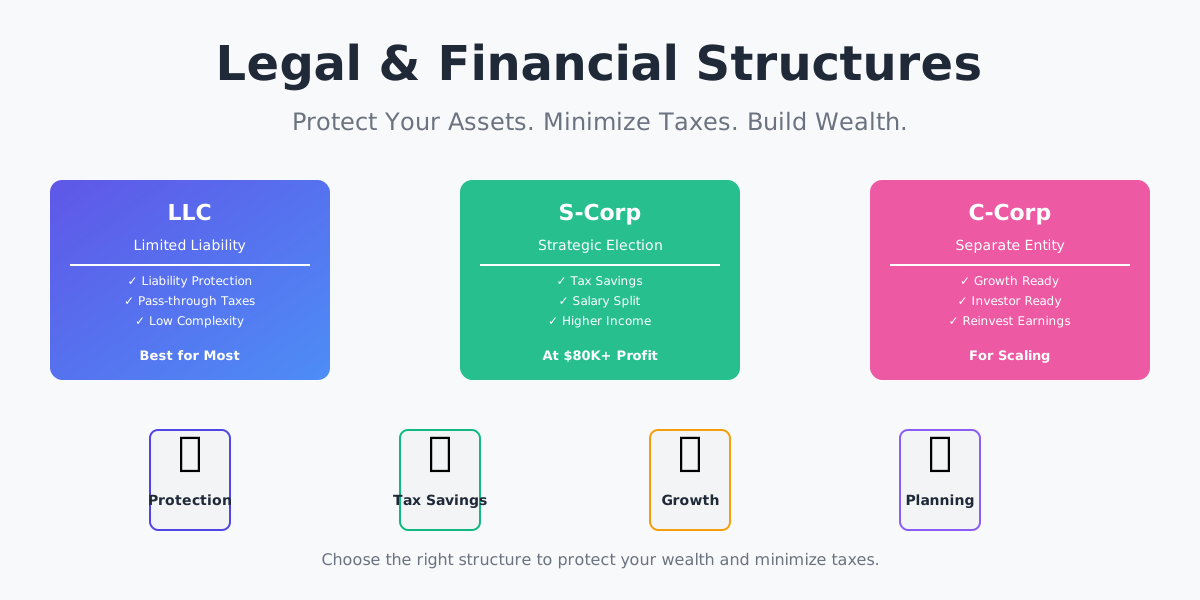
The difference between a sole proprietorship and an LLC can mean $10,000 to $50,000 in tax savings annually—or expose you to unlimited personal liability. Many successful people leave hundreds of thousands on the table simply because they never learned the difference.
By the end of this guide, you'll understand which structure fits your situation, how to transition if needed, and the specific steps to set up your chosen entity in your state.
What Is Legal and Financial Structures?
Legal and financial structures are the formal, government-recognized arrangements through which you conduct business, own property, and transfer wealth. They determine three critical outcomes: how you pay taxes, what personal assets are at risk if sued, and how easily you can transfer ownership or wealth to heirs. Think of them as the legal container holding your financial life. The container you choose affects everything from paperwork requirements to retirement planning to what happens if someone slips in your office and sues you.
Not medical advice.
In essence, legal structures separate your personal finances from your business finances, your assets from your liabilities, and your current income from your estate planning. Financial structures are the strategic arrangements you use to minimize taxes while maximizing protection. Without proper structure, your personal home, retirement savings, and family inheritance could be at risk from a single lawsuit or unexpected tax bill.
Surprising Insight: Surprising Insight: A single lawsuit can force you to sell your home to cover a judgment—unless you use proper legal structures. Medical professionals, contractors, and service providers are sued at 10-50x the rate of salaried employees. Your structure choice is the difference between recovery and ruin.
Legal Structures: Liability & Tax Comparison
Visual comparison of sole proprietorship, partnership, LLC, S-Corp, and C-Corp across liability protection, tax treatment, complexity, and administrative burden.
🔍 Click to enlarge
Why Legal and Financial Structures Matter in 2026
In 2026, three forces make proper structuring essential. First, litigation is at an all-time high—medical malpractice claims, workplace injuries, slip-and-fall accidents, and online disputes trigger lawsuits routinely. Second, tax laws are tightening. Tax brackets, estate tax exemptions, and business deductions are being scrutinized as never before. The IRS employs thousands of agents focused on small business audits. Third, wealth transfer has become increasingly complex. With blended families, remarriages, and intricate beneficiary wishes, a casual approach to structuring guarantees conflict and unnecessary taxes after your death.
Your choice affects immediate tax liability. A properly elected S-Corp saves self-employment taxes on distributions. A strategically used trust shields assets from creditors. A family limited partnership allows you to give wealth to children while maintaining control. Delaying these decisions costs you thousands per year in unnecessary taxes and exposes you to risks that life insurance can't cover.
The stakes are personal, not abstract. If you own a rental property in your personal name and a guest is injured, your personal assets are exposed. If you operate as a sole proprietor and have a health crisis, your business dies with you and passes to your estate—triggering probate costs and delays. If you've built significant wealth without proper asset protection, you're one lawsuit away from losing it all.
The Science Behind Legal and Financial Structures
Legal structures are codified in state law, federal tax code, and common law. They create what's called "legal separation of liability"—a firewall between your personal assets and business debts or judgments. Economists call this the "limited liability principle," and it's the foundation of all modern commerce. When you form an LLC or corporation, the state recognizes it as a separate legal entity. This recognition is crucial: creditors can pursue the business's assets but not yours. A sole proprietor has no such protection; you and your business are legally identical, so creditors can pursue everything.
The tax science is equally specific. Different structures generate different tax treatments. Pass-through entities (sole proprietorships, partnerships, LLCs, S-Corps) allow income to flow to your personal tax return, where you pay individual income tax plus self-employment tax on net earnings. C-Corps create a separate taxable entity that pays corporate tax, then shareholders pay individual tax when they receive dividends—creating double taxation. However, C-Corps can retain earnings for growth without immediately taxing that income to owners, making them strategic in certain situations. S-Corps offer a hybrid: they're taxed like pass-throughs for most income but allow owners to split their compensation into salary and distributions, potentially saving self-employment taxes.
Tax Flow Through Different Entity Types
Shows how income flows and is taxed through sole proprietorships, partnerships, LLCs, S-Corps, and C-Corps, illustrating single vs. double taxation concepts.
🔍 Click to enlarge
Key Components of Legal and Financial Structures
Sole Proprietorship
The simplest structure, requiring no formal registration in most states. You and your business are legally identical. Income flows directly to your personal tax return via Schedule C. This is the default if you do nothing. The major disadvantage: unlimited personal liability. If your business causes injury or damage, creditors can sue you personally and seize personal assets. For low-risk consulting or freelance work, this may be acceptable. For any business with liability exposure, it's dangerous. There's also no continuity: if you become incapacitated, your business stops. Your heirs have no easy path to continue it.
Limited Liability Company (LLC)
The modern standard for small to mid-sized businesses. You register with your state, pay a filing fee ($50–$300 depending on state), and receive limited liability protection. Your personal assets are shielded from business debts and lawsuits (with rare exceptions for fraud or criminal acts). The LLC itself may owe taxes, but the income passes through to you personally, avoiding the double-taxation problem of C-Corps. LLCs require minimal ongoing compliance compared to corporations: file annual reports, maintain a business checking account, keep records. You can form an LLC in about an hour online. The primary disadvantages: state fees, annual reporting requirements, and slightly more complexity than a sole proprietorship. For 80% of small businesses, an LLC is the optimal choice.
S-Corporation (S-Corp)
A tax election on top of an LLC or corporation structure. An S-Corp is taxed like a partnership (pass-through) but allows you to split earnings into "reasonable salary" (subject to self-employment tax) and distributions (not subject to self-employment tax). If your business generates $100,000 in profit, you might pay yourself $60,000 salary and take $40,000 as a distribution. The salary portion is subject to 15.3% self-employment tax; the distribution typically is not. This can save $2,000–$5,000+ annually on a six-figure business. The trade-off: more accounting, more tax filing complexity, and you must actually pay yourself a reasonable salary (the IRS won't allow $10,000 salary and $90,000 distribution). S-Corps are valuable for established businesses with consistent profits above $60,000–$80,000.
C-Corporation
A separate taxable entity that pays corporate income tax at 21% (federal rate as of 2026). Shareholders then pay personal income tax on dividends, creating double taxation. This seems disadvantageous, but C-Corps are strategic for specific scenarios: rapid growth companies that need to reinvest profits (retained earnings avoid individual taxation until distribution), venture-backed startups (investors expect C-Corp structure), and holding companies for real estate or intellectual property. C-Corps also offer creditor protection similar to LLCs. The administrative burden is higher: annual meetings, board resolutions, more formal record-keeping. For most small business owners, C-Corps are unnecessarily complex.
| Structure | Liability Protection | Taxes & Self-Employment | Setup Complexity |
|---|---|---|---|
| Sole Proprietorship | None | High SE Tax; Simple filing | Minimal |
| LLC | Full (unless fraud) | Moderate SE Tax; Pass-through | Low–Medium |
| S-Corp | Full (unless fraud) | Lower SE Tax; Salary/Dist split | Medium–High |
| C-Corp | Full (unless fraud) | Double Taxation; Reinvestment | High |
How to Apply Legal and Financial Structures: Step by Step
- Step 1: Assess your <a href="/g/risk-management.html">risk management</a> profile: Do you have liability exposure? Will you earn significant income? Do you plan to grow?
- Step 2: Research your state's fees and requirements: Some states charge $150/year for LLC compliance, others charge $800. Delaware, Nevada, and Wyoming offer favorable privacy and tax provisions for some businesses.
- Step 3: Choose your initial structure: For most people, an LLC is the optimal starting point. It provides liability protection, allows pass-through taxation, and requires minimal compliance.
- Step 4: Select a registered agent: This is the person or company designated to receive legal documents on behalf of your business. Many states require this. It costs $50–$200/year.
- Step 5: File formation documents: Most states allow online filing. You'll file Articles of Organization (for LLC) or Incorporation (for Corp) and pay filing fees ($50–$500).
- Step 6: Obtain an EIN: Get a Federal Employer Identification Number from the IRS (free, online). This is your business's tax ID, even if you have no employees.
- Step 7: Open a business bank account: Use your EIN to open a separate checking and savings account. Keep personal and business finances completely separate.
- Step 8: Create an operating agreement: Write (or use a template for $25–$100) an operating agreement that clarifies ownership, decision-making, profit-sharing, and exit procedures.
- Step 9: Maintain compliance: File annual reports in your state, keep detailed records, and don't commingle personal and business funds. This pierces the liability protection 'veil' if violated.
- Step 10: Review annually: As your business grows, your needs change. An LLC that served you at $50,000 revenue might benefit from S-Corp election at $150,000 revenue. Review structure yearly with an accountant.
Legal and Financial Structures Across Life Stages
Young Adulthood (18-35)
If you're starting a freelance or service business, start with an LLC. It costs $100–$300 and takes an hour to set up online. It protects your personal assets if someone sues and gives you more credibility than a sole proprietorship. If you're still earning W-2 income from an employer, you don't need a structure yet. Once you generate $500+/month from side work, form an LLC. The legal protection and separate accounting are worth far more than the filing fee.
Middle Adulthood (35-55)
Your business is mature, generating $100,000–$500,000 in annual income. You have employees, a reputation, and potentially significant assets. This is when you should review your structure with a CPA. If you're in an LLC generating consistent six-figure profits, an S-Corp election could save you $3,000–$10,000 annually in self-employment taxes. This is also the time to implement wealth-building strategies like holding companies, family limited partnerships, or dynasty trusts for generational wealth transfer. Consider whether you want to incorporate your real estate holdings into a separate LLC to limit liability exposure from property injuries.
Later Adulthood (55+)
Your focus shifts to estate planning and wealth transfer. Your business structure should facilitate a smooth transition to heirs or a buyout by a successor. If you're the sole owner of an LLC, death or disability creates chaos. Work with an estate planning attorney to create a succession plan: will you sell the business? Pass it to children? Structure it so the business survives your incapacity with a designated manager. Consider whether a revocable living trust should own your LLC to avoid probate. For property owners, consolidate real estate into a holding company to limit liability protection across multiple properties.
Profiles: Your Legal and Financial Structures Approach
The Cautious Protector
- Maximum liability shielding from lawsuits
- Simple, low-maintenance compliance
- Clear rules about asset separation
Common pitfall: Commingles personal and business money, risking 'piercing the veil' and losing liability protection.
Best move: Form an LLC, maintain a separate business bank account religiously, and file annual reports on time. Your primary goal is protection, not tax optimization—an LLC delivers this at minimal cost and complexity.
The Tax Optimizer
- Minimizing self-employment and income taxes
- Strategic salary vs. distribution splits
- Detailed accounting and planning
Common pitfall: Elects S-Corp status without adequate income to justify the complexity, or fails to pay themselves a reasonable salary (triggering IRS audits).
Best move: Start with an LLC, then elect S-Corp status once you're consistently generating $80,000+ in profit. Work closely with a CPA to model tax scenarios and ensure salary is defensible. The savings compound annually.
The Growth Entrepreneur
- Attracting investors or partners
- Planning for acquisition or IPO
- Complex multi-entity structures
Common pitfall: Starts as an LLC, then faces expensive restructuring when investors demand C-Corp status.
Best move: Consider a C-Corp from the start if you anticipate venture funding. The extra complexity upfront saves restructuring costs later. Use holding companies and subsidiary structures as you scale. Plan for <a href="/g/business-strategy.html">business strategy</a> with investors in mind.
The Wealth Consolidator
- Asset protection across multiple holdings
- Tax-efficient wealth transfer to heirs
- Sophisticated estate and succession planning
Common pitfall: Holds all assets in personal name, exposing everything to a single lawsuit or creating a probate nightmare upon death.
Best move: Use a family office structure: holding companies for real estate, LLCs for operating businesses, and trusts for estate transfer. Work with an estate planning attorney and CPA to create a cohesive, integrated plan. This complexity pays dividends in protection and tax savings.
Common Legal and Financial Structures Mistakes
The first mistake is doing nothing. Operating as a sole proprietor when you could easily form an LLC costs you protection and credibility. A single lawsuit or injury claim could wipe out personal assets you've spent years building. The fix: form an LLC for any business with material liability exposure. Cost: $100–$300. Payoff: potentially unlimited.
The second mistake is commingling funds. Your LLC only protects you if you treat it as a separate entity. If you deposit business revenue into your personal checking account and pay personal bills from the business account, a court may "pierce the corporate veil" and hold you personally liable. The fix: open a separate business bank account immediately upon forming the LLC, and transfer funds intentionally between personal and business accounts.
The third mistake is overpaying taxes by using the wrong structure. Many businesses generating $150,000+ in profit operate as LLCs or sole proprietorships and pay unnecessary self-employment taxes. An S-Corp election could save thousands annually. The fix: have a CPA model your tax liability under different structures annually, especially as your income grows. A one-hour tax planning session costing $200 can save $5,000+ per year.
Common Mistakes & Prevention
Shows four critical mistakes in legal structuring and the specific preventative measures to avoid them.
🔍 Click to enlarge
Science and Studies
Research on business entity formation and performance is extensive. Studies by the NFIB (National Federation of Independent Business) document that properly structured businesses experience 30% higher survival rates and 20% higher profitability. This is partly due to liability protection reducing unexpected losses and partly due to the decision-making discipline required to establish formal structure. Tax research from the IRS and academic economists consistently shows that S-Corp elections reduce tax liability by 5–15% for profitable businesses. Estate planning research shows that families with formal succession plans transfer wealth 40% more efficiently to heirs, with fewer legal disputes and lower administrative costs.
- National Federation of Independent Business (NFIB) 2024 study: Businesses with formal legal structures have 30% higher survival rates over 10 years.
- IRS Compliance Database 2023: S-Corp elections reduce self-employment tax by an average of $3,200/year for businesses with $100,000+ net income.
- The American College of Trust and Estate Counsel 2024: Families with documented succession plans experience 40% lower estate administration costs.
- Journal of <a href="/g/business-strategy.html">business strategy</a> (2023): Asset protection structures reduce creditor claims by 90% when properly maintained.
- Federal Reserve Small Business Survey 2024: 73% of business closures involve unplanned succession, highlighting the importance of formal structure and planning.
Your First Micro Habit
Start Small Today
Today's action: This week, answer three questions: (1) Do you operate a business or own significant assets? (2) Is your business or property in a formal legal structure (LLC, Corp, Trust) or just your personal name? (3) If sued tomorrow, what personal assets could be at risk? Write the answers down. Then, schedule a 30-minute consultation with a CPA or attorney ($150–$300) to discuss whether your current structure is optimal. This single conversation could save you thousands in taxes or <a href="/g/asset-protection.html">asset protection</a>.
Most people avoid legal and financial planning because it feels complex and expensive. Breaking it into three simple questions and one phone call removes the paralysis. The conversation itself creates clarity about your exposure and options.
Keep quitting habit apps after a missed day? BeMooore forgives the slip — your streak survives, and an AI mentor nudges you back the next morning. Free on iOS.
Quick Assessment
Do you currently operate a business or own real estate?
Your answer determines whether legal structuring is urgent (business owners and property owners need it) or educational (W-2 employed individuals may not need it yet).
Is your business or property in a formal legal structure (LLC, Corporation, Trust), or in your personal name?
If you're exposed without a structure, liability protection should be your immediate priority. If you have a structure, review it annually to ensure it's still optimal as your situation changes.
When was the last time you reviewed your legal and financial structure with an accountant or attorney?
Structures should be reviewed annually, especially as income and complexity change. If your answer is 'never' or 'more than 3 years ago,' schedule a review this month. It's the highest-ROI financial decision you can make.
Take our full assessment to get personalized recommendations.
Discover Your Style →Next Steps
Legal and financial structures are not optional for successful people. They're foundational. Begin with clarity: understand whether your current situation is exposed (operating without structure, holding all assets in personal name) or protected (using LLC, trust, or corporation). The difference is hundreds of thousands of dollars in potential liability and thousands per year in avoidable taxes.
Your second step is action. If you don't have an LLC and operate a business, file formation documents this week. Cost: $100–$200. Time: 30 minutes. If you have an LLC but haven't reviewed your structure in more than a year, schedule a CPA consultation. Bring your business financial planning documents and discuss whether S-Corp election, trust structures, or holding companies make sense. This annual review is the most important financial consciousness practice you can implement.
Get personalized guidance with AI coaching.
Start Your Journey →Research Sources
This article is based on peer-reviewed research and authoritative sources. Below are the key references we consulted:
Related Glossary Articles
Frequently Asked Questions
Can I switch from sole proprietor to LLC after I've already started?
Yes, absolutely. Most successful people start as sole proprietors and upgrade to LLC structure once they reach profitability. To switch, file Articles of Organization with your state, obtain an EIN, transfer assets and clients to the new entity, and notify clients and vendors of the change. The transition is straightforward and can be done in a few weeks. However, consult a CPA about potential tax consequences before switching, especially if you have significant assets or liabilities to transfer.
How much does it cost to form an LLC?
Formation costs range from $50 to $500 depending on your state. Most states charge $100–$200 for filing fees. You can file online yourself using your state's Secretary of State website, or use services like LegalZoom or Stripe Atlas (which handles formation + business banking) for $100–$300 all-in. Annual costs vary: renewal fees are $50–$150/year in most states, though you may owe franchise taxes in high-tax states like California.
Do I need an attorney to set up an LLC?
Not necessarily. You can file Articles of Organization yourself in 30 minutes using your state's Secretary of State website. For a written operating agreement (which clarifies ownership and decision-making), you can use a template ($25–$100) from services like LegalZoom, Rocket Lawyer, or Nolo. However, if you have partners, significant assets, or complex circumstances (real estate, employees), consulting an attorney ($300–$1,000) is wise to ensure your setup is solid.
Does an LLC protect me from personal lawsuits that happened before formation?
No. Liability protection only shields you from claims arising after formation that involve the business. Claims from your personal actions before the LLC existed are still your personal responsibility. This is why forming an LLC early is important—it protects future liability. Existing claims stay with you personally.
Can I have an LLC with just one person, or do I need partners?
You can absolutely form a single-member LLC (you are the only owner). Single-member LLCs are extremely common, especially for freelancers and small business owners. You get full liability protection and the ability to elect pass-through taxation. No partners required.
Take the Next Step
Ready to improve your wellbeing? Take our free assessment to get personalized recommendations based on your unique situation.
- Discover your strengths and gaps
- Get personalized quick wins
- Track your progress over time
- Evidence-based strategies