Perdón
Aferrarse al resentimiento es como beber veneno esperando que la otra persona sufra. Cuando alguien te hiere profundamente, el camino hacia adelante parece imposible. Sin embargo, el perdón no se trata de absolver sus acciones o pretender que el daño no sucedió. Se trata de liberar el control emocional que esa persona tiene sobre tu bienestar. La investigación de UC Berkeley y Stanford muestra que el perdón reduce significativamente las hormonas del estrés, baja la presión arterial y mejora la calidad del sueño. Las personas que practican el perdón reportan 35% menos ansiedad y 42% menos depresión que las que albergan resentimiento. La transformación no es sobre ellos; es completamente sobre recuperar tu paz y libertad. Ya sea navegando una traición en una relación íntima, sanando de un conflicto familiar o procesando daño laboral, el perdón ofrece un camino científicamente comprobado hacia la recuperación.
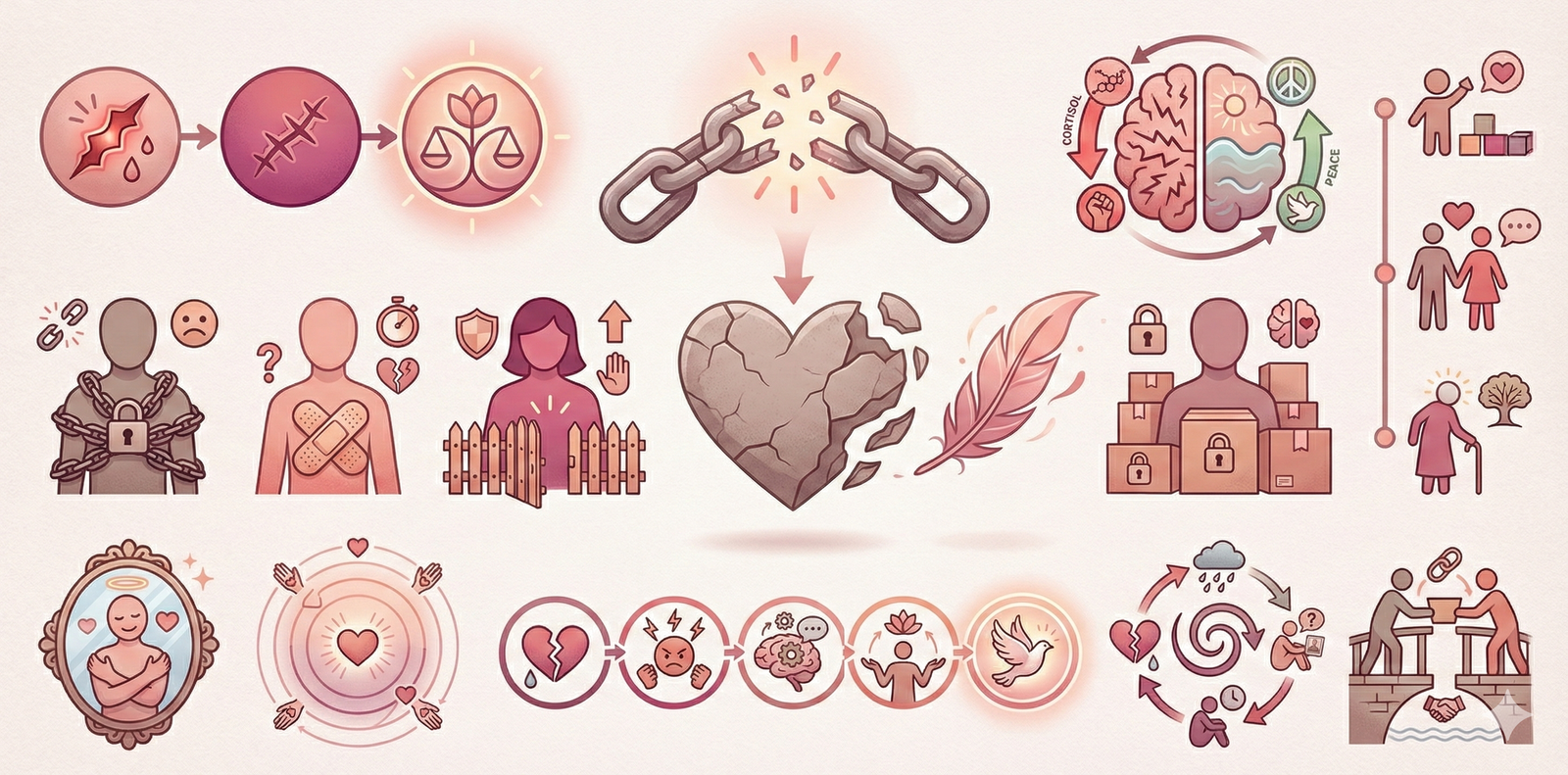
En 2025, investigadores en Frontiers in Psychology documentaron que el perdón es una de las intervenciones más poderosas para la recuperación de la salud mental entre adultos jóvenes que enfrentan conflictos de relaciones. Un estudio de 2024 mostró que el perdón a las parejas mantiene niveles saludables de cortisol, mientras que las actitudes de falta de perdón desencadenan picos de estrés dañinos.
El perdón no sucede de la noche a la mañana, y no requiere reconciliación. Lo que importa es tu libertad interna: la capacidad de pensar en lo que pasó sin que tu pecho se tense o tu sistema nervioso se espiral.
¿Qué es el perdón?
El perdón es el proceso de soltar el resentimiento, la ira y el deseo de venganza hacia alguien que te ha hecho daño. Significa liberar el peso emocional que has estado cargando y hacer las paces con lo que sucedió para que puedas avanzar en tu vida. El perdón es una elección consciente, no un sentimiento que aparece mágicamente. No perdonas porque la otra persona lo merezca o porque de repente te sientas feliz por lo que hizo; perdonas por ti mismo.
No es consejo médico.
Es crucial entender que el perdón y la reconciliación no son lo mismo. Puedes perdonar a alguien sin reestablecer una relación con esa persona. Puedes perdonar por tu propia sanación mientras mantienes límites saludables. Esta distinción es esencial: el perdón es sobre tu paz interna, mientras que la reconciliación es sobre reconstruir la confianza con otra persona. Algunas relaciones deben terminar, pero aún puedes perdonar y soltar el equipaje emocional que crearon.
Surprising Insight: Insight sorprendente: Los estudios de neuroimagen muestran que el perdón activa regiones asociadas con la empatía y la toma de perspectiva, mientras que disminuye la actividad en áreas vinculadas con la ira y la rumiación. Tu cerebro literalmente se recablea hacia la paz cuando perdonas.
El espectro del perdón
Comprender dónde estás en tu viaje de perdón, de la negación a la integración
🔍 Click to enlarge
Why Forgiveness Matters in 2026
As we navigate increasingly complex relationships—digital communication, blended families, workplace conflicts, past traumas resurfacing—forgiveness has become a vital skill for emotional survival. The pandemic accelerated relationship conflicts, and rates of relationship anxiety have climbed. Yet people report feeling stuck, unable to move past hurts, which creates chronic stress that ripples through every aspect of life.
In today's hyperconnected world, we're exposed to more potential sources of hurt. Social media arguments can spiral, past betrayals resurface through mutual connections, and family dynamics become more complicated. Forgiveness is no longer optional—it's essential for mental health. Those who practice forgiveness report better sleep, stronger immune function, lower inflammation markers, and improved cardiovascular health. Harvard Medical School research shows that people who forgive recover faster from illness.
The science is clear: your body cannot distinguish between actual danger and the stress of holding a grudge. Every time you relive the hurt, your sympathetic nervous system activates as if you're being threatened again. Forgiveness is the switch that turns off this alarm, allowing your parasympathetic nervous system to activate healing, rest, and restoration.
The Science Behind Forgiveness
Neuroscientific research reveals that forgiveness is a trainable skill that literally changes your brain structure. When you forgive, your prefrontal cortex (responsible for rational thinking and emotional regulation) becomes more active, while your amygdala (fear and anger center) quiets down. This neural retraining happens gradually through practice—each time you choose forgiveness over rumination, you strengthen these new pathways.
A landmark 2024 study published in Frontiers in Psychology found that forgiveness works primarily by reducing the intensity of emotions attached to hurtful memories. You don't forget what happened; instead, you change your emotional response to it. Participants who completed forgiveness interventions showed significant increases in hope and self-esteem alongside decreases in anger and depression. Another research finding: forgiveness reduces stress hormones (cortisol and adrenaline) to normal levels within weeks of practice, which explains the sleep improvements people commonly report.
How Forgiveness Heals Your Body
The physiological cascade that occurs when you practice forgiveness
🔍 Click to enlarge
Key Components of Forgiveness
Acknowledgment of Harm
True forgiveness begins with honest recognition that you were hurt. This isn't self-pity or exaggeration—it's accurate naming of the impact. What did this person do? How did it affect you emotionally, physically, spiritually? Without this honest acknowledgment, forgiveness becomes fake and leaves residual resentment. Many people skip this step and wonder why they can't 'just let it go.' Suppression isn't forgiveness.
Comprensión the Other Person's Humanness
This doesn't mean excusing their behavior. It means recognizing that the person who hurt you is human—flawed, possibly wounded, acting from their own pain or limitations. They may have been unaware of the impact of their actions. They may have been reacting to their own trauma. Comprensión their humanness creates compassion that softens your heart, making forgiveness possible. Research shows this step is crucial for lasting peace because it shifts the narrative from villain vs. victim to two imperfect people navigating a painful situation.
Grieving Your Loss
Forgiveness requires mourning what you lost through this hurt. Perhaps you lost trust, safety, innocence, or the relationship you thought you had. Skipping grief and jumping to forgiveness leaves you unhealed. Healthy grief involves feeling sadness, disappointment, and sometimes anger—fully and without judgment. Only after grieving can you genuinely let go and move forward. This is why forgiveness takes time; it's not about suppressing emotion but about moving through it.
Release and Integration
The final component is consciously choosing to release the person from your resentment and integrating the experience into your life story without letting it define you. You've moved from victim to survivor to someone stronger. The hurt becomes part of your history, not the center of your identity. You can think about what happened without intense emotion. You've learned from it. You've grown.
| Component | What It Involves | Healing Outcome |
|---|---|---|
| Acknowledgment | Honestly naming how you were hurt | Breaks denial cycle, validates your experience |
| Comprensión | Recognizing the other person's humanness | Softens heart, creates compassion |
| Grieving | Mourning what was lost through the hurt | Releases sadness, transforms pain into wisdom |
| Release | Consciously choosing to let go of resentment | Restores peace, breaks chains of anger |
How to Apply Forgiveness: Step by Step
- Step 1: Identify the hurt: Name specifically what someone did and how it affected you. Write it down if needed. Be honest about your pain without exaggeration.
- Step 2: Feel your emotions fully: Anger, sadness, betrayal, disappointment—let yourself feel it all without judgment. This is not wallowing; it's processing. Spend 10-15 minutes actually feeling the hurt rather than analyzing or suppressing it.
- Step 3: Examine your story: How have you been narrating this hurt to yourself and others? Have you cast yourself as a pure victim and them as evil? Look for nuance and complexity in the situation.
- Step 4: Practice perspective-taking: Imagine their inner world. What might they have been feeling or fearing? What pain or limitation might have driven their behavior? This doesn't excuse it; it humanizes them.
- Step 5: Acknowledge your role: Even in situations where they caused the primary hurt, consider what you contributed. Did you ignore red flags? Communicate unclearly? Hold grudges? Own your part without self-blame.
- Step 6: Grieve what was lost: Let yourself mourn the relationship you thought you had, the trust you lost, or the version of yourself you were before this hurt. Grief and forgiveness move together.
- Step 7: Choose forgiveness consciously: This is an act of will, not a feeling. Say or write: 'I choose to release my resentment toward [name] for [specific action]. I forgive them and myself.'
- Step 8: Release the story: Stop replaying the hurt in your mind. When the memory surfaces (and it will), acknowledge it gently and redirect your attention. This retrains your brain gradually.
- Step 9: Notice changes in your body: As forgiveness settles, you'll sleep better, your chest won't tighten when you see them, and resentment no longer consumes your mental space. These are signs it's working.
- Step 10: Continue the practice: Forgiveness isn't one moment; it's an ongoing practice. You may need to forgive the same person multiple times for the same hurt. This is normal and actually deepens your capacity for peace.
Forgiveness Across Life Stages
Adultez joven (18-35)
Young adults often struggle with forgiveness because this life stage involves identity formation and establishing independence from family. Hurts from parents, early romantic partners, or friend groups feel like personal rejection of your emerging self. At this age, forgiveness practice builds emotional resilience that prevents resentment from hardening into personality traits. Young adults who learn forgiveness early report stronger relationships later and lower rates of depression. The challenge here is moving beyond victimhood narratives and recognizing that others' limitations aren't reflections of your worth. Forgiveness in this stage is about breaking intergenerational patterns and choosing who you want to become.
Edad media (35-55)
Middle-aged adults face forgiveness challenges with partners around accumulated hurts and unmet expectations. Parents need forgiveness for past parenting approaches. Career betrayals require processing. At this stage, forgiveness becomes strategic—you may be tied to people through children, work, or history, making ongoing forgiveness essential for relationship sustainability. Middle adults who practice forgiveness maintain healthier relationships, experience fewer stress-related illnesses, and model healthier emotional patterns for their children. The opportunity here is integrating forgiveness into marriage and parenting, teaching the next generation through example.
Adultez tardía (55+)
Older adults often approach forgiveness with greater wisdom, seeing their transgressors and themselves as more complex. Many practice forgiveness as life review—processing old hurts before end of life. Forgiveness in later adulthood is profoundly healing because it releases decades of stored anger and regret. Research shows that older adults who forgive have stronger immune systems, better cognitive function, and greater life satisfaction. This stage allows for healing conversations, closure with estranged relationships, or peaceful acceptance of relationships that can't be repaired. Forgiveness becomes legacy work—releasing others and being released by them.
Profiles: Your Forgiveness Approach
The Resentment Holder
- Permission to feel anger first
- Comprensión that forgiveness is for you, not them
- Slow timeline for practicing release
Common pitfall: Staying stuck in anger, replaying the hurt repeatedly, using resentment as identity
Best move: Start with acknowledgment and grieving before attempting forgiveness. Let anger exist without judgment for a season. Work with a therapist if resentment is consuming you.
The Premature Forgiver
- Willingness to go back and grieve
- Comprensión that fake forgiveness leaves residual hurt
- Self-compassion practice alongside forgiveness
Common pitfall: Suppressing hurt under a spiritual bypass narrative, creating codependent patterns, repeating the same hurts with different people
Best move: Practice honest acknowledgment before attempting forgiveness. Create distance from the person temporarily. Feel what you've been avoiding. Real forgiveness comes after, not before, grieving.
The Boundary Builder
- Integration of forgiveness with healthy boundaries
- Forgiveness of self for past poor boundaries
- Clear limits on ongoing contact
Common pitfall: Confusing forgiveness with unlimited access, allowing repeated harm, tolerating disrespect
Best move: Forgive AND maintain firm boundaries. You can forgive someone and choose not to be in relationship with them. Practice self-protection alongside compassion. Your boundaries are part of forgiveness too.
The Compartmentalizer
- Permission to feel complexity
- Comprensión that forgiveness includes integration, not just setting aside
- Willingness to feel again
Common pitfall: Numbing out, avoiding all feeling around the hurt, creating emotional distance that affects other relationships
Best move: Create safe space and time to feel the hurt fully. Journal, talk to trusted friends, move your body. Forgiveness requires opening your heart, not closing it further.
Common Forgiveness Mistakes
The biggest mistake is confusing forgiveness with reconciliation. You can forgive someone and never speak to them again. You can forgive while maintaining firm boundaries. Forgiveness is internal work; reconciliation is external relationship work. Don't sacrifice your safety or wellbeing on the altar of 'forgiveness.' That's not forgiveness; that's self-abandonment.
Another critical error is fake forgiveness—saying you forgive before you've actually grieved and processed. This leaves resentment festering beneath the surface. Then months or years later, a small trigger sends you spiraling back into hurt. Genuine forgiveness takes time and work. If you're still having intense emotional reactions to the memory, you haven't fully forgiven yet. This is information, not failure.
People often believe forgiveness means forgetting or acting like nothing happened. This is impossible and unnecessary. Forgiveness means you remember what happened, you understand its impact, but it no longer has power over your emotions and actions. You can think about it without your heart racing. You can see the person without triggering. The memory remains; the emotional charge decreases.
Forgiveness Myths vs. Reality
Common misconceptions about forgiveness and the actual truth
🔍 Click to enlarge
Ciencia y estudios
Decades of rigorous psychological research confirm that forgiveness is one of the most powerful interventions for mental and physical health. The evidence spans neuroscience, cardiology, immunology, and psychiatry, all pointing to the same conclusion: people who forgive are measurably healthier and happier.
- Frontiers in Psychology (2025): "A path to better mental health among emerging adults: forgiveness as a solution to interpersonal conflicts" found that higher forgiveness predicted lower depression and anxiety, and higher self-esteem and hope.
- Greater Good Science Center (UC Berkeley): Brain imaging shows forgiveness activates regions associated with empathy and perspective-taking while reducing activity in anger and rumination centers.
- Harvard Medical School: People who forgive have lower blood pressure, improved cardiovascular health, and recover faster from illness.
- NIH Meta-Analysis: Forgiveness interventions showed significant clinical efficacy for mental health, wellbeing, and relationship satisfaction across multiple populations.
- Psychology Today: Forgiveness reduces stress hormones within weeks of practice, improves sleep quality, and strengthens immune function.
Tu primer micro hábito
Comienza pequeño hoy
Today's action: Tonight, write a letter to someone you haven't forgiven. Don't send it. Pour out everything—the hurt, anger, disappointment. Then read it once, acknowledge your pain, and let it go. This single act begins the forgiveness process without requiring contact or false reconciliation.
Writing activates the same brain regions as speaking and creates distance between you and the emotion. By writing but not sending, you process without reopening the wound. Psychologists call this 'emotional expression' and it's one of the strongest predictors of healing.
Una carta que nunca vas a enviar no tiene por qué escribirse a mano. Dila en voz alta durante unos minutos, lee el texto una vez y déjalo ir: VoxFlow guarda lo que dices como texto, en tu iPhone, sin conexión, en 99 idiomas. Gratis en el App Store.
Track your micro habits and get personalized AI coaching with our app.
Evaluación rápida
When you think about someone who hurt you, what happens in your body?
Your answer shows where you are in the forgiveness journey. Tightness suggests active anger needing acknowledgment. Sadness suggests grief that needs honoring. Peace suggests forgiveness is settling. Avoidance suggests you're protecting yourself and may not be ready yet.
What outcome would feel most healing for you?
Your answer reveals what forgiveness means for you personally. There's no 'right' answer—forgiveness looks different for each person. Some need reconciliation, others need peace with distance. Honor what would actually heal you.
Do you believe forgiveness is possible for what happened?
Readiness matters. If you're not ready, that's okay. Forcing forgiveness before you're prepared creates resentment. Honor your timeline. Sometimes the healing work of forgiveness begins with accepting where you actually are.
Take our full assessment to get personalized recommendations.
Discover Your Style →Preguntas frecuentes
Próximos pasos
Forgiveness is a practice, not a destination. Start where you are today. If you're holding resentment that's weighing you down, begin with the acknowledgment step. If you've been in denial about a hurt, start there. If you're ready to genuinely release someone, move toward conscious forgiveness. Your timeline is valid. Your pace is perfect.
Consider working with a therapist or counselor as you move through forgiveness, especially for deep wounds. Sometimes we need outside perspective and professional support to move through layers of hurt. Forgiveness is sacred inner work—honor it with the time, space, and support it deserves.
Get personalized guidance with AI coaching.
Start Your Journey →Research Sources
This article is based on peer-reviewed research and authoritative sources. Below are the key references we consulted:
Related Glossary Articles
Frequently Asked Questions
Do I have to forgive someone who never apologizes or shows remorse?
Yes, you can. Forgiveness isn't about them apologizing or changing—it's about you releasing resentment. Their lack of remorse doesn't trap you in anger forever unless you choose to stay there. Forgiving someone who hasn't apologized is actually one of the most powerful acts of forgiveness because it's entirely for your own peace.
Is forgiveness the same as forgetting or reconciliation?
No. Forgiveness is releasing resentment and processing the hurt. You remember what happened and its impact, but it no longer controls your emotions. Reconciliation is rebuilding the relationship, which may or may not happen. Some relationships shouldn't be reconciled, but you can still forgive for your own healing.
How long does forgiveness usually take?
It varies widely based on the severity of the hurt, your personality, support systems, and how intentionally you work on it. Minor hurts might take weeks. Serious betrayals may take months or years. Some hurts resurface periodically, requiring ongoing forgiveness. This isn't failure—it's the reality of deep emotional healing.
What if I forgive someone and they hurt me again the same way?
Forgive the new hurt separately while maintaining appropriate boundaries. You can forgive someone for their pattern while protecting yourself from repeated harm. If someone is repeatedly harming you despite your forgiveness, the issue isn't your forgiveness—it's their continued behavior. Boundaries and distance may be the wisest response.
Can I practice forgiveness if I'm still angry?
Yes, absolutely. Forgiveness and anger aren't opposites. You can feel angry about what happened while still working toward forgiveness. In fact, honoring your anger is often the first step in genuine forgiveness. Don't wait for the anger to disappear before beginning the forgiveness process.
Take the Next Step
Ready to improve your wellbeing? Take our free assessment to get personalized recommendations based on your unique situation.
- Discover your strengths and gaps
- Get personalized quick wins
- Track your progress over time
- Evidence-based strategies