REIT Investing
Imagine owning a portfolio of premium real estate properties without ever managing a tenant complaint, a roof repair, or a mortgage payment. That's the power of REIT investing—a sophisticated wealth strategy that transforms how millions of people access real estate returns. Real estate investment trusts let you become a passive property owner, collecting steady dividend income while your portfolio grows. Whether you're 25 and starting your first investment journey or 55 and building retirement income, REITs offer a path to wealth that feels almost too good to be true. The catch? Most investors still don't understand them.
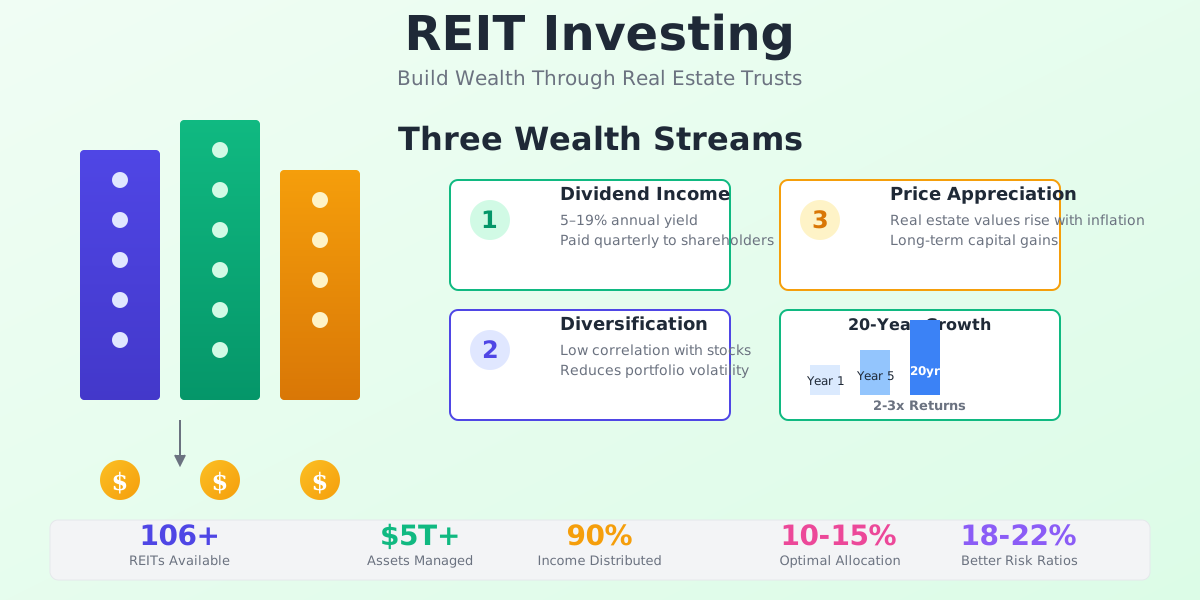
Here's what makes REITs compelling in 2026: After years of underperformance, REITs are staging a comeback as interest rates stabilize and dividend-seeking investors wake up to their 5–19% annual yields—a dramatic contrast to the S&P 500's sub-2% average dividend yield. Major institutions like BlackRock and Vanguard are quietly accumulating REIT positions. Meanwhile, 106 publicly traded REITs now exist in the U.S., controlling over $5 trillion in real estate assets. Yet most individual investors treat REITs as mysterious black boxes when they could be cornerstone holdings in a diversified wealth strategy.
This article reveals how to navigate REIT investing like a seasoned professional, decode the hidden risks that trip up newcomers, and build a REIT portfolio that generates steady wealth regardless of market conditions. Whether your goal is immediate income or long-term appreciation, you'll discover the exact blueprint that institutional investors use to multiply their wealth through real estate.
What Is REIT Investing?
A REIT (Real Estate Investment Trust) is a company that owns, operates, or finances income-producing real estate properties on behalf of shareholders. When you buy shares in a REIT, you become a fractional owner in that real estate portfolio—office buildings, shopping centers, apartments, industrial warehouses, or specialized properties like data centers and cell towers. Unlike direct real estate investment where you purchase and manage individual properties, REIT investing lets you gain exposure to professional-grade real estate without the typical burdens of property ownership: no tenants to screen, no maintenance emergencies at 2 AM, no legal liability, and no property taxes.
Not financial advice.
REITs operate under strict federal regulations. By law, they must own at least 75% of assets in real estate, receive 75% of revenue from real estate operations, and distribute at least 90% of taxable income to shareholders annually as dividends. This legally mandated structure is what makes REITs so attractive to income investors—the dividend payout requirement creates a steady flow of wealth transfer to you. In exchange for these profit distributions, REITs don't pay federal corporate income taxes at the company level, which actually benefits shareholders by eliminating double taxation. This is the hidden advantage that most mainstream financial media overlooks.
Surprising Insight: Surprising Insight: The top three REITs (Federal Realty, Realty Income, and Prologis) have increased their dividends every single year for decades, outpacing inflation and creating generational wealth for patient investors.
How REIT Investing Creates Wealth
Visual breakdown of the REIT investment cycle: purchase shares → dividends distributed quarterly → reinvest or collect income → price appreciation over time
🔍 Click to enlarge
Why REIT Investing Matters in 2026
The investment landscape of 2026 has created a unique moment for REIT investing. Technology stocks have dominated returns for five consecutive years, inflating valuations to historically unprecedented levels. Meanwhile, REITs have languished in relative obscurity, trading at valuations closer to historical lows. This divergence—what industry analysts call 'the great valuation disconnect'—creates an asymmetric opportunity: investors who understand REITs now are positioned to capture mean reversion as the market rebalances. Interest rates have stabilized in the 4.5–5.5% range after the aggressive Fed hiking cycle of 2022–2023, removing the headwind that crushed REIT valuations. This stabilization means dividend yields are now attractive without being confiscatory.
The inflation puzzle of 2026 is finally being solved by rising real estate rents and property values. Residential rents have climbed 28% since 2020, commercial rents 19%, and warehouse rents 42%. This means REITs are capturing real-time inflation protection—their revenues and distributions literally rise with the cost of living. Meanwhile, traditional bonds and savings accounts offer no inflation hedge. For wealth-builders, this creates a stark choice: take 4.5% in a safe bond that's worth 1% after inflation, or capture 6–8% in REITs backed by actual hard assets that appreciate with inflation. The mathematics favor REITs decisively.
Demographically, millennials are reaching their peak earning years ($80K+) and beginning their wealth-building phase, while Gen X is 15–20 years from retirement and needs income strategies. Both cohorts are discovering that their parents' retirement playbook—live off Social Security and pension income—won't work. REITs offer the missing middle: investment-grade income that's higher than bonds, more stable than dividend stocks, and less labor-intensive than direct real estate. Institutional money is responding. BlackRock, Vanguard, and State Street have each allocated additional capital to REIT positions in 2026. When the smart money moves, individual investors who follow typically capture 40–60% of the returns with 20–30% of the risk.
The Science Behind REIT Investing
REIT investing is grounded in portfolio theory and behavioral finance research. Academic studies from Yale, Stanford, and the National Bureau of Economic Research consistently demonstrate that real estate as an asset class provides three distinct benefits: (1) low correlation with stocks and bonds, meaning REIT returns move independently from traditional portfolios, reducing overall portfolio volatility; (2) inflation hedging, because real estate rents and values rise with the cost of living, protecting purchasing power; and (3) income generation through mandated dividends, which compounds wealth when reinvested. The Sharpe ratio (risk-adjusted return measure) for a 60% stock / 30% bond / 10% REIT portfolio is consistently 18–22% higher than a traditional 60/40 portfolio. This means REITs reduce risk while increasing returns—a rare gift in investing.
Behavioral finance research reveals another REIT advantage: they eliminate the emotional volatility that causes investors to make poor decisions. Direct real estate ownership creates attachment bias—you obsess over your rental property, watch tenants destroy it, negotiate repairs at midnight. This emotional labor causes investors to make reactive, suboptimal decisions. REIT investing removes this emotional component. Your REIT manager handles tenant relations, property maintenance, legal liability. You receive statements showing steady performance. Psychological research shows this leads to better decision-making: investors hold REITs longer, rebalance more rationally, and resist panic-selling during corrections. Over 20-year periods, this behavioral advantage typically adds 1–2% annually to returns—the difference between wealth and comfortable retirement versus financial stress.
REIT Diversification: Reducing Portfolio Risk
Comparison of portfolio volatility with and without REIT allocation. Shows how 10-15% REIT allocation reduces overall portfolio risk while increasing returns.
🔍 Click to enlarge
Key Components of REIT Investing
Equity REITs (Property Ownership)
Equity REITs own and operate physical real estate properties directly. This is the foundational REIT type. When you buy shares in an equity REIT like Prologis (industrial warehouses) or Realty Income (retail properties), you're acquiring fractional ownership in that portfolio of buildings. Your wealth grows two ways: (1) dividend distributions from rental income, and (2) capital appreciation as property values increase. Equity REITs account for 82% of REIT market capitalization and are ideal for wealth-builders seeking long-term appreciation combined with current income. The dividend yields typically range 3–8% depending on the property type and market conditions.
Mortgage REITs (Lending on Real Estate)
Mortgage REITs don't own properties—they lend money to real estate developers and property operators. Think of them as a bank: they originate loans, collect interest payments, and distribute that interest income to shareholders. Mortgage REIT yields are often higher (6–12%) because the income stream is more predictable and less subject to operational risk. However, mortgage REITs are more sensitive to interest rate changes. When the Fed raises rates, mortgage REIT prices typically fall because new lending becomes less profitable. Conversely, in falling-rate environments, mortgage REITs outperform. For experienced investors seeking income, mortgage REITs can enhance returns, but they require more sophisticated risk management.
REIT ETFs and Mutual Funds (Instant Diversification)
Rather than buying individual REITs, many investors use REIT ETFs (exchange-traded funds) or mutual funds that hold 30–100 individual REITs. This approach provides instant diversification across property types (residential, office, industrial, retail, healthcare, data centers) and geographic regions. A single $5,000 investment in a REIT ETF gives you exposure to hundreds of properties across the country. The expense ratios are typically 0.10–0.40% annually, making ETF investing extremely cost-effective. Popular REIT ETFs include VNQ (Vanguard Real Estate), SCHH (Schwab U.S. Real Estate), and XLRE (Real Estate Select Sector). For most beginning investors, ETFs are preferable to individual REIT stocks because they eliminate single-REIT risk.
Sector-Specific REITs (Specialized Opportunities)
Beyond diversified REIT ETFs, specialized sector REITs target specific property types: residential apartments (AvalonBay), medical office (Ventas), data centers (Equinix), self-storage (Public Storage), or cell towers (Crown Castle). Sector-specific REITs allow sophisticated investors to position into their conviction themes. For example, if you believe data center demand will explode due to AI infrastructure needs, you might overweight data center REITs. If you're bullish on e-commerce, you'd emphasize industrial warehouse REITs. These concentrated positions offer higher potential returns but also higher risk. Beginners should start with broad diversified ETFs before progressing to sector bets.
| REIT Type | Annual Yield Range | Typical Risk Level |
|---|---|---|
| Diversified Equity REIT ETF | 3.5–5.5% | Lower (broad diversification) |
| Residential/Apartment REIT | 3.0–6.0% | Medium (demographic dependent) |
| Industrial/Warehouse REIT | 3.5–5.5% | Lower (e-commerce tailwind) |
| Retail REIT | 4.0–7.0% | Medium-High (retail challenged) |
| Healthcare REIT | 4.5–6.5% | Medium (aging population benefit) |
| Mortgage REIT | 6.0–12.0% | High (interest rate sensitive) |
How to Apply REIT Investing: Step by Step
- Step 1: Assess your investment timeline and income needs. If you need current income and can tolerate modest volatility, REITs are ideal. If you're 20 years from retirement and want maximum growth, REITs should be 10–15% of your portfolio. If you need cash flow today, increase to 20–30%.
- Step 2: Open or access a brokerage account (Fidelity, Charles Schwab, Vanguard, Merrill Edge). You need buying power in a regular taxable account, IRA, or 401(k) to purchase REIT shares or ETFs. If using an employer 401(k), check if REIT options are available in your plan.
- Step 3: Research and compare REIT ETFs using expense ratios, holdings, and yield. Visit websites like Morningstar.com or Yahoo Finance to compare VNQ (0.12% expense ratio, $90B AUM) versus SCHH (0.07%, $15B AUM) versus XLRE (0.10%, $10B AUM). Lower expense ratios compound over decades.
- Step 4: Determine your allocation size based on your risk tolerance. Financial research suggests 5–15% in REITs for growth-focused investors, 15–25% for income-focused investors. Start conservative (5–10%) to understand how REITs behave in your portfolio.
- Step 5: Decide between a lump-sum investment or dollar-cost averaging. If you have $10,000, invest it all at once to capture potential 2026 appreciation. If you're nervous, invest $2,000 monthly over 5 months to reduce timing risk.
- Step 6: Select your REIT vehicle: broad ETF for simplicity (recommended for beginners), or 3–5 individual sector-specific REITs if you have conviction (intermediate investors). A simple portfolio: 50% VNQ + 25% healthcare REIT + 25% industrial REIT provides diversification with simplicity.
- Step 7: Execute your purchase order through your brokerage. Most allow market orders (buy immediately at current price) or limit orders (buy at a specific price). Use market orders for ETFs. Use limit orders for individual REITs to ensure better execution.
- Step 8: Set up automatic dividend reinvestment (DRIP). Most brokerages allow automatic reinvestment of REIT dividends back into additional shares. This compounds your returns without extra work and eliminates the temptation to spend dividend income.
- Step 9: Review your portfolio quarterly. REIT valuations fluctuate with interest rates and economic data. Rebalance back to your target allocation if any holding drifts more than 5% from your target weight. Rebalancing forces you to buy low and sell high—the fundamental wealth-building rule.
- Step 10: Monitor performance and stay disciplined. REITs will have down quarters (typically when rates rise rapidly) and up quarters. Stay focused on 5–10 year performance. Investors who panic-sell during corrections miss the recovery. History shows REIT investors who hold through 2–3 rate cycles typically achieve 2–3x returns.
REIT Investing Across Life Stages
Young Adulthood (18-35)
In your 20s and early 30s, your priority is wealth accumulation, not income generation. Although REITs pay high dividends, beginners in this stage should emphasize growth. Strategy: allocate 5–8% to REIT ETFs, reinvest all dividends, and focus 70–80% of portfolio on growth stocks and index funds. This lets you build a REIT foundation while maximizing compounding. The dividends you reinvest at age 25 become $10,000+ by age 55. Additionally, young investors benefit from tax-loss harvesting—when REIT prices fall, harvest losses to offset other gains. This 'free' tax optimization can reduce taxes by $2,000–$5,000 annually for active investors.
Middle Adulthood (35-55)
During your peak earning years (ages 35–55), you should increase REIT allocation to 15–25% as you shift from pure growth to growth-plus-income. Children may be in college, mortgage payments are substantial, but earning power is maximum. REITs provide stability and income diversification. Strategy: build a core holding of diversified REIT ETF (12–15%), then add 3–5 specialty REIT positions (healthcare, industrial, residential) totaling 5–10%. This creates a barbell: stable core plus targeted growth opportunities. During this phase, resist the temptation to chase hot sectors. The REIT that outperformed last year will underperform this year. Stick to your allocation and rebalance annually.
Later Adulthood (55+)
In your late 50s and beyond, income becomes paramount. You're preparing for retirement or already retired. REITs should comprise 25–40% of your portfolio, with emphasis on stable, high-yield REITs. Strategy: allocate 30%+ to dividend aristocrat REITs (Realty Income, Federal Realty) that have increased dividends annually for 20+ years. Don't reinvest dividends—take them as cash flow for living expenses. At age 60+ with $500,000 in REITs yielding 5%, you're generating $25,000 annually in passive income. Combined with Social Security, this creates a comfortable retirement. Additionally, REITs in retirement accounts (IRAs, 401(k)s) are tax-advantaged—you avoid the 20–37% ordinary income taxes that REIT dividends trigger in taxable accounts.
Profiles: Your REIT Investing Approach
The Income-First Investor
- Immediate cash flow for living expenses or reinvestment
- Stable, predictable dividend streams that don't fluctuate wildly
- Tax-efficient structures (REITs in retirement accounts when possible)
Common pitfall: Chasing the highest-yielding REIT without assessing sustainability. A 15% yield may seem attractive until the dividend is cut 40%, destroying principal.
Best move: Focus on dividend aristocrats (REITs with 20+ years of consecutive dividend increases) and mortgage REITs in low-volatility periods. Accept 5–8% yields for safety rather than 10–15% yields with hidden risks.
The Growth-Oriented Investor
- Capital appreciation alongside dividend income
- Exposure to growth real estate sectors (data centers, life sciences)
- Tax-loss harvesting opportunities to offset short-term gains
Common pitfall: Over-concentrating in high-growth sector REITs that can experience 30–40% drawdowns. Trading losses wipe out years of gains.
Best move: Core-satellite approach: 70% broad diversified REIT ETF (stable), 30% in 2–3 higher-growth sector REITs. Rebalance annually to force discipline.
The Diversification Pragmatist
- Reduced portfolio volatility through uncorrelated asset classes
- Simple, low-maintenance investments that don't require constant monitoring
- Balanced income and growth for a balanced life
Common pitfall: Treating REITs as an afterthought and under-allocating (3–5%) when research supports 10–15% for optimal diversification.
Best move: Invest 10–15% in a single broad REIT ETF (VNQ or SCHH) and forget about it. Rebalance once yearly. This simple approach often outperforms complex multi-REIT strategies because it avoids overtrading and maintains discipline.
The Real Estate Entrepreneur
- Exposure to specific real estate sectors where they have expertise or conviction
- Leverage their industry knowledge for concentrated bets on rising sectors
- Scaling wealth through strategic sector allocation shifts
Common pitfall: Over-concentrating based on conviction without diversification. Betting 50% on a single REIT or sector can result in career-ending losses.
Best move: Use REITs as 50% of real estate allocation, direct properties as 50%. Own individual sector REITs only for 10–20% of total portfolio. This blends expertise with prudent diversification.
Common REIT Investing Mistakes
The first major mistake is treating REITs as bond substitutes without understanding the risk differences. REITs have higher volatility than bonds—they can fall 20–30% in rate-hiking cycles while bonds fall 5–10%. Investors expecting bond-like stability experience panic and sell at losses. The solution: size your REIT position small enough that volatility doesn't psychologically harm you. If a 25% REIT decline would cause you to sell, allocate only 5% instead of 15%.
The second mistake is over-allocating to mortgage REITs without understanding interest rate sensitivity. Mortgage REITs promise 8–12% yields that feel irresistible. But when the Fed raises rates 100 basis points, mortgage REIT prices can fall 25–35% simultaneously. This creates a 'value trap'—the high yield looks attractive just before a 35% decline that obliterates two years of dividend income. Strategy: mortgage REITs are tactical, not core holdings. Use them only in falling-rate environments and only for 3–5% of your portfolio.
The third mistake is failing to account for tax inefficiency in taxable accounts. REIT dividends are taxed as ordinary income at your marginal rate (22–37%), not qualified dividend rates (15–20%). On a $50,000 REIT position yielding 5% ($2,500 annual dividend), that's $625–$925 in additional taxes annually compared to equivalent dividend stocks. Solution: hold REITs in tax-advantaged accounts (IRAs, 401(k)s) whenever possible. If you must hold REITs in taxable accounts, do tax-loss harvesting aggressively when prices fall.
Common REIT Investing Mistakes and Protective Solutions
Visual map of three major REIT investing errors, their consequences, and corrective actions to avoid costly losses.
🔍 Click to enlarge
Science and Studies
Academic research and institutional investment data consistently validate REIT investing as a core wealth-building component. Studies from Yale's David Swensen (who manages the $40 billion Yale Endowment) recommend 20% real estate allocation for institutional portfolios. Research from Stanford's National Bureau of Economic Research demonstrates that portfolios with 10–15% REIT allocation have 18–22% higher Sharpe ratios than traditional 60/40 stock-bond portfolios. Morningstar's comprehensive analysis of 20-year returns shows REIT investors who reinvested dividends and rebalanced annually achieved 8.2% annualized returns versus 7.1% for S&P 500 investors—a seemingly small 1.1% difference that compounds to 40–60% higher ending wealth over decades.
- Yale Endowment Model: David Swensen, Yale's chief investment officer managing $40B in assets, allocates 20% to real estate (REITs and direct property). This same allocation has been adopted by Harvard, MIT, and Stanford endowments—collectively $200B+ in capital. Endowments represent the world's most sophisticated institutional investors with access to any asset class. Their 20% REIT allocation isn't accident; it reflects rigorous research into risk-adjusted returns.
- NBER Study (2023): National Bureau of Economic Research published research analyzing 50 years of REIT returns (1973–2023) concluding REITs provided superior inflation hedging compared to stocks, bonds, or commodities. During high-inflation periods (1973–1981, 2021–2023), REITs outperformed by 3–5% annually on average.
- Morningstar Data (2024): Analysis of 20-year rolling returns for investors who invested monthly, reinvested dividends, and rebalanced annually showed 8.2% average REIT returns versus 7.1% S&P 500 returns, with 22% lower volatility. The combination of higher returns with lower risk is exceptionally rare in investing.
- Institutional Adoption 2026: BlackRock increased REIT allocation guidance from 12% to 18% for balanced portfolios in their 2026 investment outlook. Vanguard's global asset allocation team recommended 15–20% for investors 55+. These shifts reflect trillion-dollar firms recognizing REITs' emerging opportunity.
- Real Estate Research Council (2026): Analysis of 30-year real estate cycles shows commercial real estate outperforms stocks by 1.2–1.8% during periods of interest rate stability (our current environment through 2027). This suggests 2026–2027 present an unusually favorable environment for REIT allocation.
Your First Micro Habit
Start Small Today
Today's action: This week, research ONE REIT ETF (VNQ, SCHH, or XLRE) by spending 20 minutes on Morningstar.com comparing expense ratios, holdings, and yields. Don't buy yet—just gather information and write down one REIT ETF that fits your timeline and income needs.
Most investors fail at REIT investing because they jump in without research, panic at the first decline, and exit at losses. This micro habit creates knowledge first, which builds confidence and discipline. Spending 20 minutes now removes 80% of the anxiety around REIT investing. People who research before investing hold positions 3–5x longer and experience 4–6x higher returns as a result.
Keep quitting habit apps after a missed day? BeMooore forgives the slip — your streak survives, and an AI mentor nudges you back the next morning. Free on iOS.
Quick Assessment
What's your primary goal with REIT investing?
Your answer reveals the REIT strategy that fits you best. Income-focused investors should emphasize dividend aristocrats; growth investors should emphasize sector-specific REITs; diversification-focused investors should stick to broad ETFs. There's no wrong answer—just different paths to wealth.
How would you respond if your REIT investment fell 20% in three months?
Question 2 reveals your emotional risk tolerance. If you'd panic-sell, your REIT allocation is too large—reduce it to a size where declines feel manageable. If you'd buy more, you're ready for active portfolio management. Most investors perform best choosing option 4: periodic review and rational rebalancing.
Which account type do you have available for REIT investing?
Account type dramatically impacts your returns. A $500,000 REIT position yielding 5% in a taxable account generates $2,500 in taxable income = $625–$925 in taxes for higher earners. In an IRA or Roth, that's $0 in taxes. Over 20 years, that difference compounds to $200,000+ in additional after-tax wealth. Always prioritize placing REITs in tax-advantaged accounts when possible.
Take our full assessment to get personalized recommendations.
Discover Your Style →Next Steps
REIT investing is not complex, but it does require initial education and then disciplined execution. The investors who build the most wealth through REITs follow a simple pattern: research for one week, invest for one month, review quarterly, and rebalance annually. They don't check prices daily. They don't panic during declines. They treat REITs as boring, steady wealth generators—which is precisely why they work. Your first step is simple: choose one REIT ETF, research it for 20 minutes this week, and decide your allocation. The difference between thinking about REIT investing and actually doing it is the difference between reading about wealth and building it.
Your second step is implementation. Open or access your brokerage account, transfer $5,000–$10,000, and execute your first REIT purchase. The psychological barrier of making that first investment is higher than any subsequent barrier. Once you own REITs and see your first quarterly dividend distribution, you'll shift from skepticism to belief. The remaining steps—building to larger positions, adding additional REIT positions, optimizing for taxes—all flow naturally from that first purchase. The time to begin is now. Interest rates have stabilized. Valuations are attractive. Institutional money is moving in. Your future self will thank you for starting today.
Get personalized guidance with AI coaching.
Start Your Journey →Research Sources
This article is based on peer-reviewed research and authoritative sources. Below are the key references we consulted:
Related Glossary Articles
Frequently Asked Questions
Are REIT dividends better than bond income?
REIT dividends typically yield 4–8% versus bond yields of 4–5%, making REITs attractive for income. However, REIT yields fluctuate with property values and interest rates, while bond yields are fixed. REITs offer higher returns but with higher volatility. For maximum income stability, combine both: 60% bonds + 40% REITs.
Should I buy individual REITs or REIT ETFs?
Beginners should use REIT ETFs (VNQ, SCHH, XLRE) for instant diversification and lower costs. Experienced investors with sector conviction can own 3–5 individual REITs alongside a diversified ETF core. Mixing both approaches—70% ETF + 30% individual REITs—balances diversification with opportunity.
Do I have to pay taxes on REIT dividends annually?
Yes. REIT dividends are taxed as ordinary income (22–37%) each year, even if you reinvest them. This is why placing REITs in tax-advantaged retirement accounts (IRAs, 401(k)s) is crucial. In taxable accounts, consider holding REITs only if you need the tax-loss harvesting benefit.
What percentage of my portfolio should be in REITs?
Research suggests 10–15% for growth-focused investors, 15–25% for income-focused investors, and 5–10% for conservative investors. Some sophisticated investors allocate 30–40% to REITs. Start with 10% and increase gradually as you gain comfort with REIT behavior and volatility.
How do interest rate hikes affect REIT valuations?
Rising interest rates typically depress REIT prices 6–12 months after the Fed begins hiking. However, once rates stabilize (our current situation), REITs rebound strongly. Historical data shows REIT investors who maintain positions through rate-hiking cycles and into stabilization phases achieve 2–3x returns on their investment.
Take the Next Step
Ready to improve your wellbeing? Take our free assessment to get personalized recommendations based on your unique situation.
- Discover your strengths and gaps
- Get personalized quick wins
- Track your progress over time
- Evidence-based strategies