Prompt Engineering Jobs
The demand for prompt engineers has exploded by 250% in just one year, creating unprecedented opportunities in the AI revolution. As companies race to harness generative AI, skilled professionals who can craft, optimize, and manage AI interactions are becoming invaluable assets. Unlike traditional tech roles that require extensive coding expertise, prompt engineering jobs blend communication skills with AI knowledge, making it accessible to career-changers while offering substantial earning potential—from entry-level positions around $70K to senior roles exceeding $270K in top-tier firms. This emerging field represents one of the fastest-growing career paths in technology, with positions available at companies ranging from healthcare giants to financial institutions to innovative startups. Whether you're seeking a high-income opportunity, a flexible remote career, or a foothold in the AI industry, understanding the landscape of prompt engineering jobs is essential for positioning yourself for success.
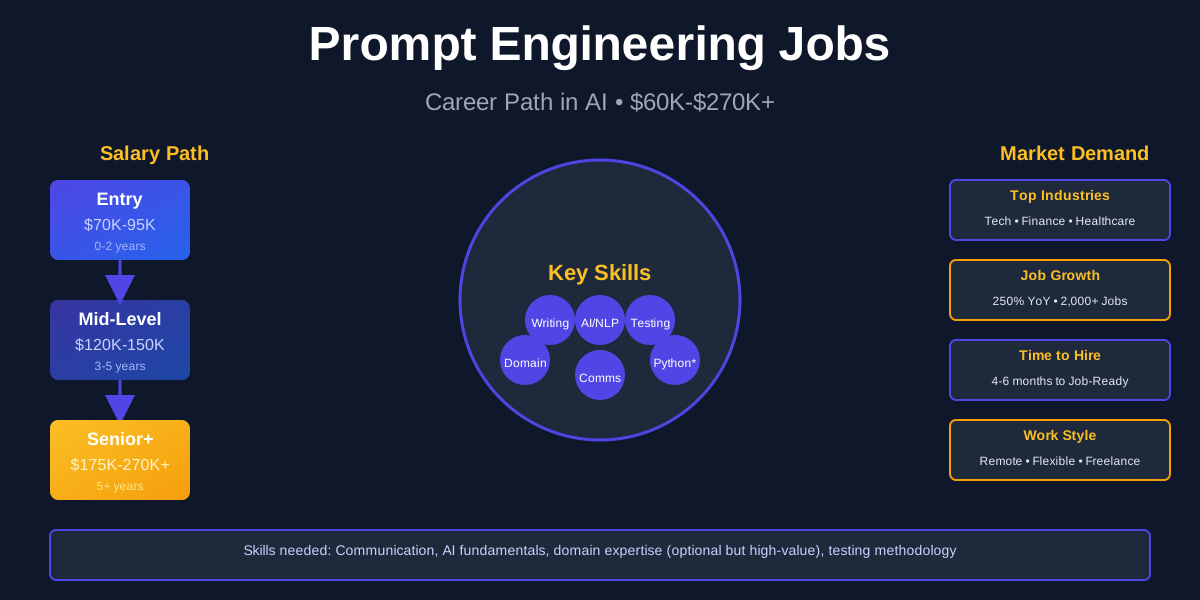
The prompt engineering field is attracting professionals from diverse backgrounds—writers, psychologists, marketing specialists, and career-changers—because the role prioritizes clear communication and strategic thinking over pure coding prowess.
By 2028, Gartner projects that 90% of organizations will have attempted implementing generative AI, creating sustained demand for prompt engineering expertise across every industry imaginable.
What Is Prompt Engineering Jobs?
Prompt engineering jobs involve designing, crafting, testing, and optimizing the instructions (prompts) given to large language models (LLMs) like ChatGPT, Claude, GPT-4, and Bard to achieve specific desired outcomes. A prompt engineer acts as an intermediary between business needs and AI capabilities, translating complex requirements into precise, effective prompts that guide AI systems to generate accurate, relevant, and valuable responses. These professionals evaluate AI outputs, iterate on prompts to improve performance, document best practices, and develop prompt libraries and frameworks that can be reused across organizations. Beyond simple prompt writing, prompt engineers analyze data, understand NLP concepts, troubleshoot model behaviors, and sometimes contribute to AI platform development itself.
Not financial advice.
Prompt engineering jobs have evolved significantly from early predictions of 'just write better questions.' In 2026, the role represents a genuine career path requiring specialized knowledge, strategic thinking, and ongoing skill development. Organizations increasingly recognize that effective prompt engineering directly impacts their AI ROI, customer satisfaction, and competitive advantage. This shift has elevated prompt engineering from a side skill to a core competency, with dedicated teams, career advancement opportunities, and competitive compensation packages in major corporations and AI-focused startups.
Surprising Insight: Surprising Insight: LinkedIn data shows that 250% increase in prompt engineering job postings within a single year, yet many dedicated prompt engineering roles exist alongside integrated roles where prompt skills combine with domain expertise (marketing, healthcare, legal) for premium compensation.
Prompt Engineering Career Landscape 2026
Visual showing job titles, industries, salary ranges, and career progression paths
🔍 Click to enlarge
Why Prompt Engineering Jobs Matter in 2026
Wealth accumulation in the AI era requires positioning yourself in high-demand, emerging fields. Prompt engineering jobs represent exactly this opportunity—they offer above-average compensation, strong growth trajectory, and accessibility compared to traditional software engineering. The field's young status means early adopters gain competitive advantages, building expertise and networks before the market saturates. For career-focused individuals seeking to maximize earning potential while maintaining work-life balance, prompt engineering offers remote work flexibility, freelance opportunities, and career advancement at a faster pace than traditional roles.
The democratization of AI through platforms like ChatGPT and Claude has created an unusual market dynamic: companies need expertise in an emerging field, but no established talent pool yet exists. This supply-demand imbalance pushes compensation upward and creates opportunities for people who acquire skills now. Early prompt engineers can command premium rates, negotiate better terms, and transition into leadership roles quickly.
Beyond individual financial benefit, prompt engineering jobs create wealth through portfolio building, AI consulting opportunities, course creation, and freelance services. Many successful prompt engineers develop secondary income streams by teaching, creating prompt libraries, building AI tools, or starting consulting practices. The skills are increasingly industry-agnostic, meaning demand spans healthcare, finance, law, education, marketing—essentially every sector using generative AI.
The Science Behind Prompt Engineering Jobs
Prompt engineering effectiveness rests on understanding how large language models work. LLMs process text through transformer neural networks, predicting the next word based on context and patterns learned during training. Skilled prompt engineers leverage this understanding to structure inputs (prompt engineering), provide relevant context (prompt injection), use examples (few-shot learning), and guide model outputs (instruction engineering). Research in prompt effectiveness shows that phrasing, example quality, and clear instructions significantly impact accuracy, relevance, and format compliance. Cognitive science principles—like chunking information, using analogies, and priming concepts—translate directly to effective prompt design. This scientific foundation differentiates good prompt engineers (who intuitively write requests) from great ones (who understand why specific phrasings optimize model behavior).
Academic research from Stanford, MIT, and OpenAI has documented techniques like chain-of-thought prompting (asking models to show reasoning), role-based prompting (assigning personas to models), and temperature/parameter optimization that measurably improve outputs. Understanding transformer mechanics, attention mechanisms, and token limits enables prompt engineers to design more sophisticated solutions. This technical foundation, combined with domain expertise, enables specialists to command premium compensation in industries like healthcare, finance, and law where prompt quality directly impacts critical decisions.
How Prompt Engineering Improves AI Output
Process flow showing input optimization and output validation
🔍 Click to enlarge
Key Components of Prompt Engineering Jobs
Prompt Creation & Optimization
Core to the role is crafting effective prompts—writing clear instructions that translate business requirements into AI interactions. This involves understanding task requirements, designing appropriate prompt structures (system prompts, user instructions, examples), testing variations, and iterating based on outputs. Optimization includes techniques like prompt chaining (breaking complex tasks into steps), temperature adjustment (controlling randomness), and output formatting (requesting JSON, structured data, specific formats). Successful prompt creators develop intuition for what works, maintain prompt version control, and document why specific phrasings produce better results.
AI Model Knowledge & Testing
Prompt engineers must understand how different LLMs (ChatGPT, Claude, GPT-4, Bard, LLaMA) behave, their strengths and limitations, training data characteristics, and capabilities at various token limits. Testing involves creating evaluation frameworks, establishing quality metrics (accuracy, tone, format compliance, safety), and running systematic tests to measure prompt performance. Many organizations require prompt engineers to build testing pipelines, track metrics over time, and validate that outputs meet compliance, accuracy, and safety standards. This technical competence differentiates prompt engineering from simple prompt writing.
Domain Expertise & Application
High-paying prompt engineering roles combine general AI skills with specialized domain knowledge. Healthcare prompt engineers understand medical terminology, compliance requirements, and clinical workflows. Finance prompt engineers comprehend investment concepts, regulatory constraints, and risk management. Legal prompt engineers know case law, document requirements, and ethical obligations. This combination of skills justifies premium salaries ($150K-$270K+) because these professionals can design prompts that address complex, high-stakes domain requirements that general prompt engineers cannot handle.
Communication & Documentation
Prompt engineers serve as translators between technical teams and business stakeholders. The role requires clear writing to document prompt libraries, maintain best practices guides, create training materials, and communicate findings to non-technical users. Strong communication skills enable prompt engineers to gather requirements effectively, present recommendations persuasively, and collaborate across teams. Many organizations prioritize communication skills as highly as technical capabilities, recognizing that insights are only valuable when effectively communicated.
| Job Title | Typical Salary Range | Primary Responsibilities |
|---|---|---|
| Prompt Engineer (Entry-Level) | $70K-$95K | Writing prompts, basic testing, documentation |
| Senior Prompt Engineer | $120K-$175K | Architecture design, team mentoring, complex projects |
| AI Prompt Specialist (Domain) | $130K-$210K | Domain expertise + prompt skills (healthcare, finance, legal) |
| Lead/Manager (Prompt Team) | $150K-$250K+ | Team leadership, strategy, organizational AI implementation |
| Freelance Prompt Engineer | $50-$150/hour | Project-based work, client consulting, specialized tasks |
How to Apply Prompt Engineering Jobs: Step by Step
- Step 1: Assess your baseline: Spend 1-2 weeks experimenting with ChatGPT, Claude, and Bard free tiers to understand how different models respond to prompts, exploring features like system messages, few-shot examples, and output formatting.
- Step 2: Take online courses: Enroll in free resources (freeCodeCamp, Coursera, DeepLearning.AI) or paid comprehensive courses covering prompt engineering fundamentals, best practices, and techniques like chain-of-thought and few-shot learning.
- Step 3: Build a portfolio: Create 10-15 well-documented prompt examples solving real problems across different domains (content creation, data analysis, coding, customer service, creative writing) with clear documentation of prompt intent and why specific techniques work.
- Step 4: Learn the technical foundation: Study transformer neural networks, NLP concepts, LLM architecture, token mechanics, and parameters (temperature, top_p, frequency penalty) so you understand why prompts work, not just that they do.
- Step 5: Practice prompt optimization: Take a single task and iteratively improve prompts, documenting how phrasing changes impact quality, speed, and accuracy to build pattern recognition for effective prompt design.
- Step 6: Develop domain expertise: Choose 1-2 industries (healthcare, finance, marketing, legal) and deepen knowledge in those areas, understanding domain terminology, challenges, and where AI can add value.
- Step 7: Build evaluation frameworks: Create systematic approaches to measure prompt performance using metrics like accuracy, relevance, format compliance, tone consistency, and speed so you can validate improvements objectively.
- Step 8: Network strategically: Join AI communities (Reddit's r/PromptEngineering, LinkedIn groups, Discord servers), contribute insights, share your work, and connect with people in companies actively hiring prompt engineers.
- Step 9: Create your online presence: Write articles on LinkedIn or Medium about your prompt engineering experiments, maintain a GitHub repository with well-documented prompts, and build credibility as someone knowledgeable in the field.
- Step 10: Apply strategically: Target roles at companies actively investing in generative AI (tech companies, finance, healthcare, e-commerce) starting with roles that combine prompt engineering with your existing domain expertise for competitive advantage.
Prompt Engineering Jobs Across Life Stages
Young Adulthood (18-35)
This life stage represents the ideal entry point for prompt engineering careers. Young adults have flexibility to invest in skill development, adapt quickly to new technologies, and take calculated career risks. The 18-35 demographic should focus on building foundational skills, creating impressive portfolios, and establishing themselves as early experts. Career strategy: invest 3-6 months in intensive learning, build 15-20 portfolio projects, target entry-level and mid-level positions ($70K-$120K) at startups or growing tech companies, and prioritize rapid skill growth over immediate maximum salary. This stage emphasizes positioning for long-term career leverage rather than immediate income maximization.
Middle Adulthood (35-55)
Mid-career professionals in the 35-55 age range bring invaluable domain expertise, professional networks, and business acumen to prompt engineering roles. This demographic is particularly valuable to organizations because combining domain knowledge (finance, healthcare, marketing, law) with prompt engineering skills creates senior-level opportunities ($130K-$210K+). Strategy: leverage existing industry expertise, position yourself as a specialist (not generalist) in your domain, target senior roles or leadership positions, and consider consulting opportunities. Many mid-career professionals successfully transition by combining previous expertise with prompt engineering, commanding premium compensation. This stage emphasizes strategic positioning, network leverage, and income maximization through specialization.
Later Adulthood (55+)
Later-career professionals can transition into prompt engineering through accumulated wisdom, expertise, and networks. Rather than competing on technical depth with younger professionals, 55+ candidates should position themselves for leadership roles, consulting, or specialized domain positions. Strategy: focus on strategic roles (management, senior consultant, director-level), leverage decades of industry expertise, consider fractional/part-time consulting opportunities, and build AI advisory roles. Many organizations value seasoned professionals as strategists and leaders in their AI transformation. This stage emphasizes leadership, wisdom-based positioning, and flexibility in work arrangements (consulting, fractional roles, remote positions).
Profiles: Your Prompt Engineering Jobs Approach
The Career-Changer
- Structured learning path with clear progression
- Portfolio-building guidance to demonstrate capability
- Confidence that non-traditional background is acceptable
Common pitfall: Underestimating domain expertise value; thinking you need computer science background when writing/psychology/business expertise is actually valuable
Best move: Invest 4-6 months in intensive learning, build 12-15 portfolio projects showing breadth, then target entry-level roles at companies investing heavily in AI transformation; your career transition narrative is actually compelling
The Domain Expert
- Fast-track learning focused on AI/prompt fundamentals without coding deep dives
- Validation that domain expertise dramatically increases compensation potential
- Strategy for positioning as specialized expert (not generalist)
Common pitfall: Thinking you need to learn coding; underpricing yourself because you don't have years of tech industry experience
Best move: Learn prompt engineering fundamentals quickly (8-12 weeks), then focus on building domain-specific prompt applications; position yourself as 'healthcare AI specialist' or 'finance prompt expert'—this expertise commands $150K-$210K+ salaries
The Technical Professional
- Connection between existing technical skills and prompt engineering opportunity
- Permission to step back from coding complexity into strategic prompt work
- Understanding that prompt engineering offers career acceleration compared to traditional software roles
Common pitfall: Overcomplicating prompt engineering; trying to code solutions when strategic prompting is more valuable; staying in traditional tech roles when AI represents faster growth
Best move: Transition by combining technical background with AI expertise; target senior or leadership roles ($120K-$180K+); leverage your technical credibility to move into strategy/architecture quickly; consider consulting to maximize income
The Freelancer/Entrepreneur
- Portfolio that demonstrates prompt engineering capability to clients
- Pricing strategy for freelance prompt services ($50-$150/hour)
- Business model ideas beyond hourly work (AI tools, courses, prompt libraries)
Common pitfall: Treating this like traditional freelance writing; underpricing because you're unsure of value; not building passive income opportunities
Best move: Build diverse income: billable client projects ($75-$150/hour), digital products (prompt libraries, templates, tools), online courses teaching prompt engineering; establish high-value positioning as specialist; most successful freelancers earn $80K-$150K+ through portfolio approach
Common Prompt Engineering Jobs Mistakes
Assuming you need advanced coding skills before applying: Many career-changers delay entering the field believing they need Python expertise or computer science backgrounds. Reality: While some prompt engineer roles involve coding, many prioritize communication and strategic thinking. Starting your job search with demonstrated portfolio pieces and growing into technical skills is a viable path. Don't wait for 'perfect' technical preparation—start with 3-6 months of learning and apply to roles matching your current ability level.
Building broad portfolios instead of deep specialization: Showing 20 mediocre prompts across 10 domains is less impressive than showing 8 exceptional prompts in healthcare or finance combined with real domain knowledge. Hiring managers prefer specialists because domain expertise directly increases value and salary. Early in your career, pick 1-2 domains to specialize in, build deep capability there, then expand.
Not testing and measuring prompt effectiveness: Documenting 'I wrote this prompt and it works' is insufficient. Serious organizations want to see systematic testing, quality metrics, edge case handling, and documented improvements over iterations. Building a reputation for rigor (not just intuition) significantly increases your market value and justifies higher compensation.
Common Mistakes in Prompt Engineering Career Development
Decision tree showing mistake paths and better alternatives
🔍 Click to enlarge
Science and Studies
Research on prompt engineering effectiveness, AI job market development, and compensation trends comes from multiple credible sources documenting the field's emergence and trajectory. Studies from leading universities, industry research firms, and hiring platforms provide evidence-based insights into skills, salary, and market demand.
- Coursera 2026 prompt engineering salary research shows average US compensation at $138,000 annually with top earners exceeding $200,000 in specialized roles
- LinkedIn job posting analysis documents 250% year-over-year growth in prompt engineering positions, indicating accelerating demand
- Gartner prediction that 90% of organizations will attempt generative AI implementation by 2028 projects sustained long-term demand for prompt engineering expertise
- OpenAI and Stanford research on prompt engineering effectiveness demonstrates measurable improvements in output quality through structured techniques like chain-of-thought and role-based prompting
- Indeed and ZipRecruiter job market analysis shows average compensation of $62,977 to $138,000 depending on experience level, location, and industry specialization
Your First Micro Habit
Start Small Today
Today's action: Spend 15 minutes experimenting with ChatGPT or Claude: write one prompt for a real problem you face (work, personal project, learning something), test 3 variations, note which produces the best result, and document why you think that variation worked better.
This micro-habit builds prompt intuition without overwhelming commitment. You immediately experience how phrasing impacts outputs, develop hypothesis-testing thinking, and start building the experiential foundation that separates excellent prompt engineers from average ones. Daily repetition over 30 days creates surprisingly sophisticated prompt engineering intuition.
Keep quitting habit apps after a missed day? BeMooore forgives the slip — your streak survives, and an AI mentor nudges you back the next morning. Free on iOS.
Quick Assessment
What's your current experience level with AI tools like ChatGPT or Claude?
Your starting point determines how much foundational learning you need versus jumping into specialization. Complete beginners need 4-8 weeks of structured learning before portfolio building, while experienced users can begin building portfolios immediately.
Do you have deep expertise in any specific domain (healthcare, finance, marketing, legal, etc.)?
Domain expertise is a significant salary multiplier. People combining prompt engineering skills with healthcare or finance expertise command $150K-$210K+, while generalists start at $70K-$95K. If you have domain expertise, position it strategically.
What's your primary motivation for exploring prompt engineering jobs?
Your motivation shapes your ideal pathway. Income-focused candidates should target companies and specialization. Career-changers need portfolio building and entry-level strategy. Entrepreneurs should consider freelance and product-based models. Skill developers can explore roles matching existing capabilities.
Take our full assessment to get personalized recommendations.
Discover Your Style →Next Steps
Your prompt engineering career path depends on your starting position. Career-changers should immediately enroll in 1-2 structured courses (freeCodeCamp offers free 1-hour beginner course; Coursera offers comprehensive paid options), dedicate 3-4 weeks to fundamentals, then spend 4-8 weeks building portfolio projects. Domain experts can accelerate by focusing on prompt fundamentals specifically rather than general AI knowledge, then leverage existing expertise for specialization. Technical professionals should consider how prompt engineering represents faster career progression than traditional engineering roles.
Beyond learning basics, strategic positioning matters enormously. If you have healthcare, finance, marketing, or legal expertise, emphasize this during your job search—companies pay premiums for domain-specialized prompt engineers. If you're entering without domain expertise, choose one area to specialize in (healthcare, e-commerce, education) and build deep knowledge there during your portfolio-building phase. Generalists compete on breadth; specialists command higher compensation and faster advancement.
Get personalized guidance with AI coaching.
Start Your Journey →Research Sources
This article is based on peer-reviewed research and authoritative sources. Below are the key references we consulted:
Related Glossary Articles
Frequently Asked Questions
Do I need a computer science degree to become a prompt engineer?
No. While a degree can help, many successful prompt engineers hold degrees in psychology, writing, history, business, or have no traditional computer science background. Skills and demonstrated capability matter more than credentials. Build a strong portfolio and you can compete effectively without a technical degree.
How long does it take to become job-ready as a prompt engineer?
4-6 months for entry-level readiness with dedicated learning and portfolio building. This involves 3-4 months learning fundamentals and techniques through courses, practice, and experimentation, plus 1-2 months building a portfolio of 12-15 projects demonstrating capability. Alternatively, if you have domain expertise (healthcare, finance, legal), you can accelerate to 8-12 weeks by combining domain knowledge with rapid prompt engineering fundamentals.
What's the realistic salary progression for prompt engineers?
Entry-level positions start at $70K-$95K. Within 2-3 years, with specialization, you can reach $120K-$150K. Senior roles or domain specialization command $175K-$210K. Top-tier positions with leadership responsibility reach $250K-$300K+. Freelancers typically charge $50-$150/hour, working 20-30 hours weekly can yield $50K-$90K annually depending on pricing and utilization. Starting aggressively and building specialization enables fastest progression.
Will prompt engineering jobs become obsolete as AI improves?
Unlikely in the near term. While AI capabilities improve, so do complexity and requirements. The parallel is software engineering: as tools improved, software engineering didn't disappear—it evolved and expanded. Expect prompt engineering to evolve from 'writing good prompts' to 'designing sophisticated AI interaction systems' combining multiple models, safety guardrails, evaluation frameworks, and integration with enterprise systems. The field is growing, not shrinking, through 2028 and beyond per Gartner projections.
Can I transition to prompt engineering from a non-tech career?
Yes, easily. Prompt engineering doesn't require traditional programming experience—it prioritizes communication, critical thinking, and domain knowledge. Marketing professionals, writers, business analysts, healthcare workers, and lawyers successfully transition by building prompt engineering skills. If anything, non-tech background with domain expertise is highly valuable because companies want specialists. Your unique combination is an asset, not a barrier.
Take the Next Step
Ready to improve your wellbeing? Take our free assessment to get personalized recommendations based on your unique situation.
- Discover your strengths and gaps
- Get personalized quick wins
- Track your progress over time
- Evidence-based strategies