High-Yield Savings Accounts
Your emergency fund is sitting in a traditional savings account earning 0.39% APY while high-yield savings accounts (HYSAs) offer 4-5% APY in March 2026. That difference means on a $10,000 emergency fund, you're leaving roughly $350 on the table every year. High-yield savings accounts are fully FDIC-insured, liquid, and require minimal effort—yet most people overlook them. This guide shows you exactly how HYSAs work, why they matter for wealth-building, and how to find the best rates without taking on any risk.
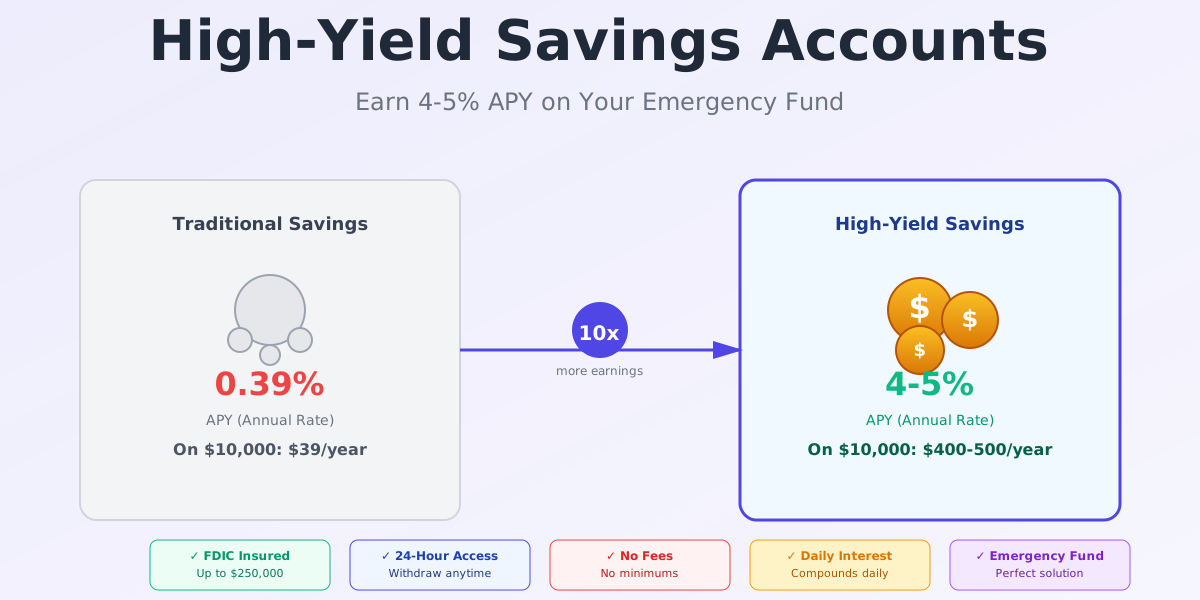
Think of a high-yield savings account as a bridge between keeping money safe and making it work for you. It's the financial equivalent of finding money in your old jeans—except it's completely legitimate, insured by the government, and available to withdraw within 24 hours if you need it.
The mechanics are surprisingly simple: online banks with lower overhead costs pass those savings to you through higher interest rates. No tricks, no minimums (usually), no complicated rules. Just your money earning substantially more while staying completely accessible.
What Is High-Yield Savings Accounts?
A high-yield savings account (HYSA) is a deposit account offered primarily by online banks that pays significantly higher interest rates than traditional savings accounts—typically 3.5% to 5.0% APY as of March 2026. The account is FDIC-insured up to $250,000, offers immediate access to your money, and has no investment risk. You deposit funds, earn interest daily, and can withdraw anytime without penalties.
Not financial advice.
The 'high-yield' part comes from the Federal Reserve's interest rate policy. When the Federal Reserve sets a higher federal funds rate (the rate banks charge each other for overnight loans), banks pass those rates to consumers. From 2022-2023, the Fed raised rates aggressively, allowing online banks to offer 4-5% APY on savings. As of March 2026, the Federal Reserve holds rates steady at 3.50%-3.75%, and leading HYSAs offer rates between 4.0% and 5.0%.
Surprising Insight: Surprising Insight: Your money earns roughly 10x more in a high-yield savings account (4% APY) than a traditional savings account (0.39% APY)—with identical safety and liquidity.
HYSA vs Traditional Savings: Annual Earnings Comparison
Bar chart comparing annual interest earned on $10,000 across three account types: traditional savings earning $39/year, money market earning $195/year, and HYSA earning $400-500/year.
🔍 Click to enlarge
Why High-Yield Savings Accounts Matter in 2026
In 2026, HYSAs solve a critical wealth-building problem: inflation erodes purchasing power. With inflation historically around 2.5-3% annually, a traditional savings account earning 0.39% is actually losing money in real terms. A high-yield savings account earning 4% APY provides a real return (after inflation) of approximately 1-1.5%—protecting your wealth rather than depleting it.
Emergency funds are the foundation of financial resilience. Financial experts recommend maintaining 3-6 months of living expenses in liquid savings. If you earn $4,000/month, that's $12,000-$24,000 sitting in your account. The difference between earning 0.39% and 4% on $20,000 is $770/year—enough to cover car maintenance, medical copays, or reduce debt payoff timelines.
Beyond emergency funds, HYSAs serve as a wealth-accumulation tool for intermediate goals: saving for a down payment (1-3 years away), funding a sabbatical, or building a transition cushion before career changes. You need your money accessible but would rather earn interest than keep it in a checking account.
The Science Behind High-Yield Savings Accounts
The relationship between Federal Reserve policy and HYSA rates demonstrates basic economics: banks manage funding costs and competitive positioning. When the Fed raises rates, online banks can offer higher deposits because they have more interest-earning opportunities (lending money at higher rates). The spread between the Fed rate and HYSA rates represents the bank's margin—currently about 0.5-1.25% based on March 2026 data.
Behavioral finance explains why most people don't use HYSAs despite the 10x earnings advantage: inertia, lack of awareness, and mental accounting (money in checking feels 'safe' because it's familiar). Psychologists call this 'status quo bias'—we stick with default options even when alternatives are objectively better. Understanding this bias is the first step to overcoming it and building wealth intentionally.
How Banks Pass Interest Rate Increases to Consumers
Flow diagram showing: Federal Reserve raises rates → banks access cheaper funding → compete for deposits → raise HYSA rates → your money earns more.
🔍 Click to enlarge
Key Components of High-Yield Savings Accounts
APY (Annual Percentage Yield)
APY is the interest rate you actually earn, including compound interest over one year. Unlike simple interest, APY compounds daily or monthly—meaning you earn interest on interest. A 4% APY on $10,000 earns approximately $408.08 over a year (not exactly $400) because of daily compounding. When comparing HYSAs, always compare APY to APY, never mix it with simple interest rates.
FDIC Insurance ($250,000 Limit)
Every deposit account in an FDIC-insured bank is protected up to $250,000 per depositor, per bank, per ownership category. This means if the bank fails, the FDIC (Federal Deposit Insurance Corporation) guarantees you get every dollar back. Since the FDIC was created in 1933, no depositor has lost a single penny of FDIC-insured funds. This guarantee is why HYSAs are appropriate for emergency funds—they're completely safe.
Liquidity (24-Hour Access)
Unlike CDs (certificates of deposit) that lock your money for months or years, HYSAs offer immediate access. You can withdraw your full balance within 24 hours, which is essential for true emergency funds. Some banks offer same-day transfers to connected checking accounts, making access even faster.
Minimum Deposits & Fees
Top HYSA providers in 2026 require as little as $0-$1 to open an account and charge no monthly fees, no maintenance fees, and no penalties for withdrawals. Compare this to traditional banks often requiring $500-$2,500 minimums. The lack of fees means 100% of your interest earnings stay with you.
| Bank/Provider | APY Rate | Minimum Deposit |
|---|---|---|
| Varo Money | Up to 5.00% | $0 |
| Axos Bank | 4.21% | $0 |
| Newtek Bank | 4.20% | $0 |
How to Apply High-Yield Savings Accounts: Step by Step
- Step 1: Compare current APY rates across 3-5 leading HYSA providers using bankrate.com, nerdwallet.com, or fortune.com—rates change frequently and even 0.25% differences matter on large balances.
- Step 2: Choose a provider based on your priorities: highest APY, best customer service, or additional features (some banks offer checking accounts, credit cards, or investment accounts).
- Step 3: Gather your documents: valid government ID (driver's license or passport), Social Security number, and current address proof.
- Step 4: Start the online application: most banks let you apply completely online in 10-15 minutes without leaving home.
- Step 5: Connect your external bank account for the initial deposit: provide your checking account routing and account numbers, or make a wire transfer.
- Step 6: Fund your account: deposit your first contribution ($1-$25,000 depending on your emergency fund goal).
- Step 7: Wait for verification: the bank typically confirms your identity within 24-48 hours.
- Step 8: Set up automatic transfers: establish monthly transfers from checking to HYSA (e.g., $500/month) to automate your emergency fund building.
- Step 9: Track your interest earnings: watch your balance grow from both deposits and daily interest compounding.
- Step 10: Monitor rate changes: HYSAs adjust rates quarterly when Fed policy changes, so check your rate annually and switch banks if competitors offer significantly higher rates (1% difference warrants a move).
High-Yield Savings Accounts Across Life Stages
Young Adulthood (18-35)
Your HYSA is your financial safety net during career building and potential instability (job changes, moves, education). Aim for $3,000-$10,000 (1-3 months of expenses) and treat it as untouchable except for genuine emergencies. The compound interest over 10+ years matters: $300/month in a 4% HYSA grows to approximately $43,000 by age 35 just from deposits and interest, before any promotions or income increases.
Middle Adulthood (35-55)
Your HYSA should contain 6 months of expenses ($24,000-$60,000 for most households) plus short-term savings for known expenses: car maintenance, home repairs, insurance deductibles. You might also hold 1-2 years of major purchase funds (replacement vehicle, home improvements) in an HYSA while deciding between immediate purchase or continuing to save for a better position.
Later Adulthood (55+)
Your HYSA remains essential: 1-2 years of retirement expenses in liquid, safe accounts provides psychological security during market downturns. If retiring at 65 on $50,000 annual expenses, holding $75,000-$100,000 in an HYSA means you can live 15-20 months without touching investments—allowing stock portfolios to recover from recessions without forced selling.
Profiles: Your High-Yield Savings Account Approach
The Starter (Building First Emergency Fund)
- Automatic transfers to make saving easy
- Lowest possible minimum deposit
- Clear account tracking interface
Common pitfall: Opening an account, depositing $50, then never adding to it because saving feels overwhelming.
Best move: Set up a $100-200 monthly automatic transfer from checking to HYSA. In 2 years, you'll have $2,400-4,800 plus interest—a legitimate emergency cushion requiring zero willpower.
The Optimizer (Maximizing Existing Emergency Fund)
- Highest APY rates available
- Rapid rate-change alerts
- Multiple account options for different goals
Common pitfall: Opening a HYSA at 4.2% three years ago and forgetting about it while better rates at 5.0% become available.
Best move: Quarterly rate check (set phone reminders for March, June, September, December). If a competitor's APY is 0.5%+ higher, move your balance in one day—earning that extra 0.5% on $20,000 is $100/year.
The Goal-Saver (Multiple Savings Objectives)
- Multiple sub-accounts or savings 'buckets'
- Banks offering both checking and savings
- Easy inter-account transfers
Common pitfall: Mixing emergency fund money with down-payment savings, then panicking when you touch it for a 'semi-emergency.'
Best move: Open 2-3 HYSAs at different banks: Emergency (untouchable), Goal (car/home down payment), Opportunity (job transition fund). Keeping them separate provides psychological protection.
The Consolidator (Simplifying Finances)
- All-in-one banking platform
- Competitive rates plus other banking services
- Minimal account switching
Common pitfall: Keeping savings scattered across 5 different banks, losing track of balances, or missing rate increases.
Best move: Choose one primary HYSA provider that also offers checking/investing (SoFi, Marcus, Ally), then automate everything. One login for all your money makes saving a system, not a struggle.
Common High-Yield Savings Account Mistakes
Mistake 1: Confusing HYSAs with money market accounts or CDs. Money market accounts sometimes have limited withdrawal options and higher minimums. CDs lock your money for fixed terms. HYSAs are the only account combining high APY + immediate access + low minimums. Choose HYSAs for emergency funds and short-term goals; CDs are better for longer-term savings where you won't need access.
Mistake 2: Chasing APY bonuses without reading terms. Some banks offer 5.5% APY but only on the first $5,000—the remainder earns 3.5%. Others require monthly direct deposits or minimum balance requirements. Always read the fine print: the headline rate applies to what amount, and what conditions must you meet?
Mistake 3: Opening an HYSA but never funding it because you're waiting to have 'extra money.' This is the behavioral finance trap: you wait for money to magically appear, months pass, no fund exists. Instead, open an HYSA with $1 today and set up a $100/month automatic transfer. Consistency beats perfection.
The True Cost of Inaction: $0.39% vs 4% Over 10 Years
Comparison chart: $200/month saved for 10 years at traditional 0.39% APY yields approximately $24,100 total. Same deposits at 4% HYSA yield approximately $28,900—a $4,800 difference from literally doing nothing differently except picking a better account.
🔍 Click to enlarge
Science and Studies
Research on behavioral finance reveals systematic obstacles to wealth-building: people dramatically underestimate the power of compound interest, suffer from status quo bias (staying with the default), and often feel that switching accounts is 'too complicated' even though it takes 20 minutes. Studies from the Journal of Financial Planning show that automating savings (having money move automatically to HYSAs) increases savings rates by 40-60% compared to manual transfers that require willpower.
- Federal Reserve: Federal funds rate policy (March 2026 analysis) shows how central bank decisions cascade into consumer interest rates within 30-90 days.
- FDIC: Deposit insurance guarantees confirm zero historical losses for insured accounts, establishing absolute safety as distinguishing HYSA feature.
- Bankrate & NerdWallet: Market rate analysis (March 2026) documents current HYSA rates (4-5% APY) vs. traditional accounts (0.39% APY).
- Psychology Today: Behavioral finance research on status quo bias explains why people don't switch to obviously better financial products.
- Journal of Financial Planning: Studies on savings automation show 40-60% higher savings rates when transfers are automatic vs. manual.
Your First Micro Habit
Open Your HYSA Today (15 minutes)
Today's action: Visit bankrate.com, pick the #1 rated HYSA, open an account online, and deposit $50. That's it. Don't aim for perfection—just start.
Opening an account creates psychological commitment. The $50 deposit establishes the system. Future deposits grow exponentially from this tiny first step. You'll start seeing interest deposits (even $0.50/month) which reinforces the behavior.
Track your savings goal in the Bemooore app—get personalized coaching on building wealth through consistent micro habits.
Quick Assessment
How much do you currently have in an emergency fund?
If you answered $0-2,000, opening an HYSA and setting up automatic transfers is your #1 wealth-building priority. Financial experts unanimously recommend 3-6 months expenses. A $200/month automatic transfer puts you there in 1-2 years.
What's your current savings account earning in APY?
If you don't know or earn less than 4%, you're likely costing yourself hundreds annually. Checking your rate takes 2 minutes online. If you're earning less than market rates, switching takes 20 minutes and increases earnings immediately.
What scares you most about opening a new bank account?
Fear of the unknown is normal. Reality check: HYSA money is 100% FDIC-insured, opening takes 15 minutes online, and the only 'complexity' is daily interest compounding in your favor. The real risk is NOT opening one.
Take our full Wellbeing Assessment to get personalized recommendations for building wealth.
Discover Your Financial Style →Next Steps
Step 1: Check your current savings account APY right now. Log into your bank, find the account details. If it's below 1%, you're in the wrong account. The switch takes less time than reading this article.
Step 2: Open a high-yield savings account today using bankrate.com, nerdwallet.com, or fortune.com to see current rates. Spend 15 minutes opening an account and depositing $50-100 to get started. Don't wait for the 'perfect' moment or more money—start small and automate the rest.
Track your savings goals and get AI-guided recommendations in the Bemooore app.
Get Personalized Wealth Coaching →Research Sources
This article is based on peer-reviewed research and authoritative sources. Below are the key references we consulted:
Related Glossary Articles
Frequently Asked Questions
Is my money really safe in a high-yield savings account?
Yes, completely. FDIC insurance protects up to $250,000 per depositor per bank. Since the FDIC was founded in 1933, zero depositors have lost insured funds even during bank failures. Your HYSA is equally safe as traditional savings accounts—just with 10x higher interest rates.
Will I have penalties if I need to withdraw my emergency fund?
No. HYSAs offer immediate access with no withdrawal penalties. You can move your full balance to checking within 24 hours. This is what makes HYSAs ideal for emergency funds—they're safe AND liquid. (CDs charge penalties for early withdrawal; don't use those for emergency funds.)
What happens to my HYSA interest rate when the Federal Reserve changes rates?
Banks adjust HYSA rates in response to Fed changes, but not immediately. When the Fed raises rates, HYSAs typically increase rates within 30-90 days (sometimes faster in competitive markets). When Fed cuts rates, HYSAs usually drop rates within weeks. Monitor rates quarterly; if your bank lags competitors by 0.5%+, switching is a valid strategy.
Can I have multiple HYSAs at different banks?
Yes! FDIC insurance covers $250,000 per bank, so holding multiple accounts at different institutions protects larger balances. Example: Account A with Bank 1 ($250K), Account B with Bank 2 ($250K) = $500K total protection. Many people use separate accounts for separate goals (emergency fund, down payment, opportunity fund) to maintain psychological boundaries.
How do I choose between so many HYSA options?
Compare using these criteria: (1) Current APY rate, (2) Minimum deposit requirement, (3) Online banking usability, (4) Customer service reputation. Sites like Bankrate.com and NerdWallet.com compare rates daily. Start with the highest APY from a bank with positive reviews. You can always switch later if rates change dramatically.
Take the Next Step
Ready to improve your wellbeing? Take our free assessment to get personalized recommendations based on your unique situation.
- Discover your strengths and gaps
- Get personalized quick wins
- Track your progress over time
- Evidence-based strategies