How to Start Adversity Management for Parents
Parenting is adversity management. Sleepless nights. Endless decisions. Watching your child struggle and knowing you cannot fix everything. The pressure to be strong while feeling anything but. You need strategies that work for you and translate to your children.
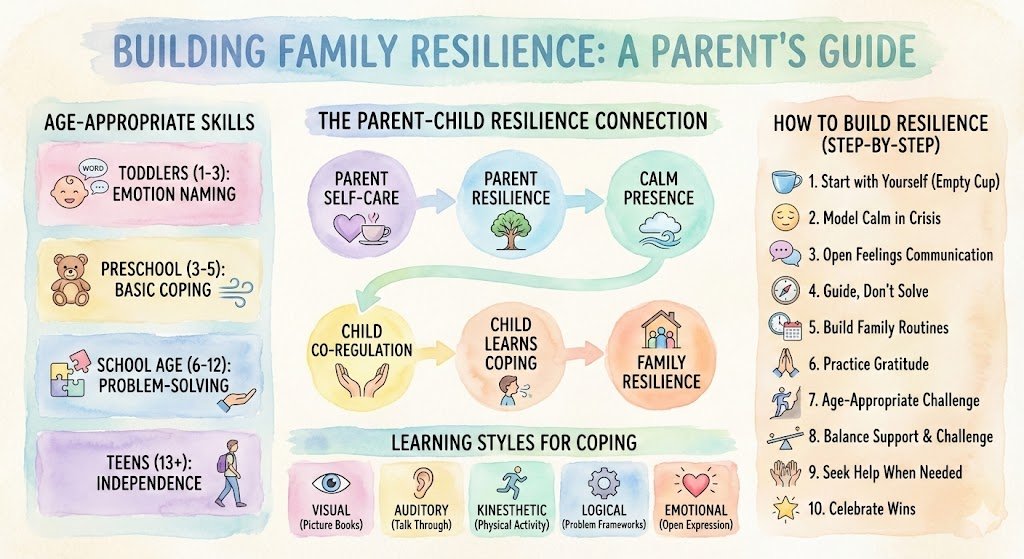
This guide addresses the unique challenge parents face: building their own resilience while modeling it for their children. You will learn why your coping matters more than what you teach, and how to build a family culture of healthy adversity management.
Vídeo: Raising Resilient Kids
The Parent-Child Resilience Connection
Surprising Insight: Perspectiva Sorprendente: Children learn resilience more from watching you handle stress than from any lesson you teach. Your nervous system regulates theirs. Your calm creates their calm. See the Practice Playbook for how.
Why Parent Resilience Matters
You cannot give what you do not have. Depleted parents cannot effectively teach resilience. Your own adversity management is not selfish. It is the foundation for your family's wellbeing.
Standards and Context
No es consejo médico.
Family Resilience System
How parent resilience flows to child resilience.
🔍 Click to enlarge
Age-Appropriate Resilience Building
| Age | Focus | How to Teach |
|---|---|---|
| Toddlers (1-3) | Emotion naming | Name feelings aloud; use picture books |
| Preschool (3-5) | Basic coping | Breathing exercises; comfort objects; routines |
| School age (6-12) | Problem-solving | Guide through challenges; let them struggle productively |
| Teens (13+) | Independence | Support autonomy; be available without hovering |
| All ages | Modeling | Let them see you cope; narrate your process |
Required Tools and Resources
- Self-care practices you can actually maintain
- Age-appropriate language for discussing emotions
- Family routines that provide stability
- Support network of other parents
- Professional help when needed
How to Build Family Resilience: Step by Step
- Step 1: Start with yourself: you cannot pour from an empty cup
- Step 2: Model calm in crisis; children watch your every response
- Step 3: Create open communication about feelings at home
- Step 4: Teach problem-solving by guiding rather than solving
- Step 5: Build family routines that provide predictability
- Step 6: Practice gratitude together at meals or bedtime
- Step 7: Let children experience age-appropriate challenge
- Step 8: Avoid both overprotection and neglect of support
- Step 9: Seek help when needed; model healthy help-seeking
- Step 10: Celebrate resilience wins as a family
Practice Playbook
Beginner: Self-First
Focus entirely on your own resilience for two weeks. Build one self-care practice. Notice your stress responses. This is not selfish; it is foundational. You must have resilience to share it.
Intermediate: Modeling
Begin narrating your coping aloud. 'I feel frustrated. I am going to take a breath before responding.' Let children see your process. Create one family resilience ritual: gratitude at dinner or weekly family meeting.
Advanced: Family Culture
Resilience becomes family identity. Everyone knows strategies. Challenges are discussed openly. Support is given freely. Family recovers from setbacks together. This culture will serve your children for life.
Profiles and Personalization
New Parent
- Survival strategies
- Permission to struggle
- Sleep prioritization
Common pitfall: Expecting to have it together immediately
Best move: Lower standards temporarily; survival is success
Working Parent
- Efficiency
- Guilt management
- Quality over quantity time
Common pitfall: Guilt spirals that drain energy
Best move: Present attention matters more than total hours
Single Parent
- Support network building
- Self-compassion
- Help acceptance
Common pitfall: Trying to do everything alone
Best move: Build your village deliberately; accept help
Parent of Child with Special Needs
- Specialized support
- Advocacy skills
- Extra self-care
Common pitfall: Neglecting self while caring for child
Best move: Your resilience enables you to be their advocate
Parent in Crisis
- Immediate support
- Professional help
- Permission to focus on basics
Common pitfall: Maintaining normal expectations during abnormal times
Best move: Reduce to essentials; get help; crisis passes
Learning Styles
Visual Learners
- Use picture books about emotions
- Create visual calm-down kits
- Family resilience charts
Auditory Learners
- Talk through feelings together
- Use audiobooks and podcasts
- Family discussions about challenges
Kinesthetic Learners
- Physical activity as family coping
- Hands-on calming activities
- Movement breaks during stress
Logical Learners
- Create family problem-solving frameworks
- Teach cause-and-effect of coping
- Use charts to track family wins
Emotional Learners
- Open emotional expression culture
- Validate feelings before solving
- Connect coping to family values
Science and Studies (2024-2025)
Parent stress directly affects child stress levels
Research shows parent cortisol levels correlate with child cortisol; calm parents help regulate children
Source →Children who experience supported challenges develop resilience
Age-appropriate adversity with parental support builds coping capacity better than overprotection
Source →Family routines buffer against adversity effects
Predictable routines provide stability that helps children cope with external stressors
Source →Spiritual and Meaning Lens
Parenting is one of life's most profound teachers. The challenges shape you as much as your children. Many traditions view child-rearing as spiritual formation for the parent. The adversity you face together creates bonds. The resilience you build becomes legacy.
Positive Stories
The Mother Who Stopped Hiding Stress
Setup: Elena hid all her stress from her children. She wanted to seem strong. But her tension leaked out in irritability and distance.
Turning point: A therapist suggested narrating her coping instead. 'Mommy feels frustrated. I am going to take some breaths.'
Result: Her children started using the same techniques. The household became calmer. Honest struggle replaced hidden tension.
Takeaway: Children learn more from seeing your process than from seeing your perfection.
The Father Who Built Family Resilience
Setup: After job loss, Marco was terrified his family would fall apart. He wanted to shield his kids from all stress.
Turning point: His wife suggested they face it together as a family. Age-appropriate honesty. Problem-solving as a team.
Result: The children rose to the occasion. The family grew closer. Years later, they still reference how they got through that together.
Takeaway: Shared adversity, handled well, strengthens families.
Microhabit
Transition Breath
Trigger: When you arrive home or pick up children
Action: Pause for three breaths before engaging; shift from work mode to parent mode
Reward: Enter family time present and calm instead of stressed
Frequency: Every transition to family time
Fallback plan: If you forget, take breaths during first hug
Quiz Bridge
What age are your children?
What is your biggest parenting challenge?
How is your own self-care?
Preguntas Frecuentes
Author Bio
Next Steps
Ready to build resilience for you and your family? The Bemooore app offers parent-specific practices, age-appropriate activities to do with children, and tracking for the whole family. Start with our free family resilience assessment.
Start Now →Research Sources
This article is based on peer-reviewed research and authoritative sources. Below are the key references we consulted:
Related Glossary Articles
Frequently Asked Questions
How do I build resilience when I am exhausted?
Start tiny. One breath. Five minutes alone. Exhaustion is real. Focus on the minimum viable self-care. Small acts compound.
How do I protect my children while teaching resilience?
Balance protection with supported challenge. Let them face age-appropriate difficulty while being available for support. Scaffold, do not remove all obstacles.
What if my partner parents differently?
Children can handle different styles. Focus on your own approach. Discuss differences privately. Model disagreement resolution. Consistency within each parent matters more than identical approaches.
At what age should I start teaching resilience?
Birth. Infants learn co-regulation. Toddlers learn emotion words. Each stage has appropriate lessons. It is never too early or too late to start.
What if I did not have resilient parents as a model?
You can break the cycle. Learn what you did not see. Get support. Your awareness is already a step forward. Many parents build what they never received.
How do I handle my own trauma while parenting?
Prioritize your healing. Trauma can transfer to children through stress responses. Get professional support. Your healing is a gift to your children.
Take the Next Step
Ready to improve your wellbeing? Take our free assessment to get personalized recommendations based on your unique situation.
- Discover your strengths and gaps
- Get personalized quick wins
- Track your progress over time
- Evidence-based strategies