Treasury Bonds
Treasury bonds represent one of the safest investment pathways available today, backed by the full faith and credit of the U.S. government. Whether you're building wealth for retirement, creating a stable income stream, or protecting your portfolio during market volatility, understanding treasury bonds opens doors to financial security and long-term prosperity. With yields currently ranging from 4.0%-4.25% and maturity periods up to 30 years, treasury bonds offer a powerful tool for every investor's wealth-building journey.
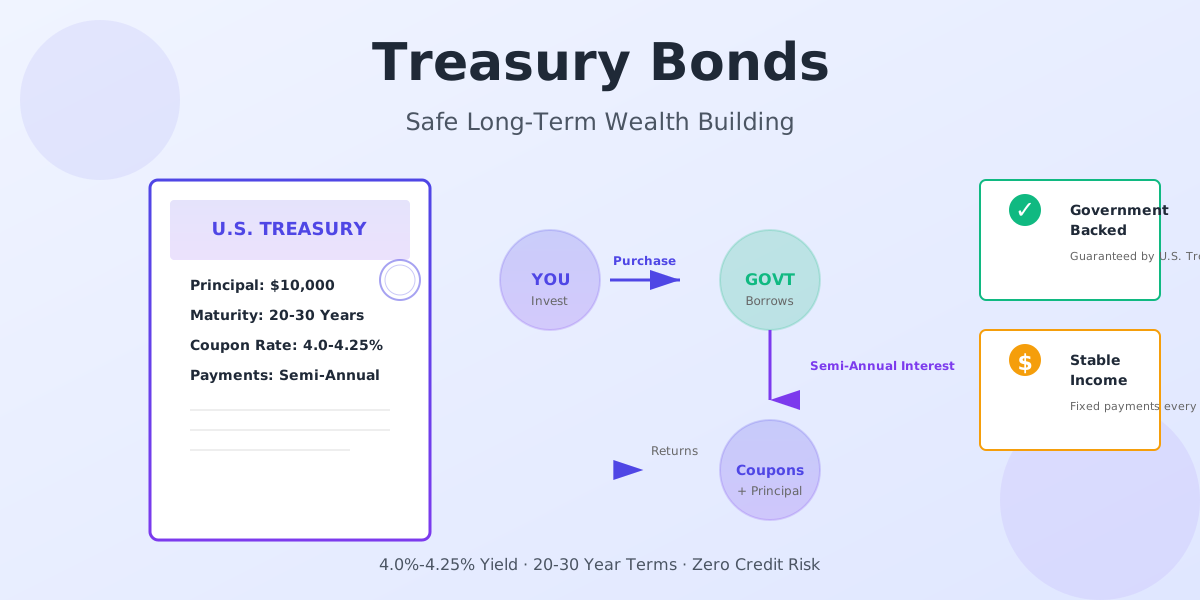
The beauty of treasury bonds lies in their predictability—you know exactly what you'll earn, when you'll earn it, and that your principal is protected by the U.S. government. This article explores how treasury bonds work, why they matter for your wealth strategy in 2026, and how to integrate them into a diversified portfolio.
From young professionals starting their first investment to retirees seeking stable income, treasury bonds serve different purposes at different life stages. This guide will show you practical steps to understand and invest in these government-backed securities.
What Is Treasury Bonds?
Treasury bonds (T-bonds) are long-term debt securities issued by the U.S. Treasury Department with maturity periods of 20 to 30 years. When you purchase a treasury bond, you're essentially lending money to the U.S. government. In return, the government guarantees to pay you a fixed interest rate every six months until the bond matures, at which point you receive your original investment back—the principal.
Not investment advice.
What makes treasury bonds unique is their safety profile. Unlike corporate bonds that depend on a company's financial health, treasury bonds are backed by the full taxing power and creditworthiness of the United States government. This fundamental difference explains why treasury bonds offer lower yields than riskier investments—the trade-off is security for potentially higher returns.
Surprising Insight: Surprising Insight: When interest rates rise, the market value of existing treasury bonds falls because new bonds offer higher yields—but if you hold to maturity, you always receive full principal, making timing less critical for long-term investors.
How Treasury Bonds Work: The Flow
Visual representation of how treasury bond payments flow from government to investor over the bond's life
🔍 Click to enlarge
Why Treasury Bonds Matter in 2026
In 2026, treasury bonds are experiencing a resurgence of investor interest. With the Federal Reserve base-case outlook calling for two to three rate cuts throughout the year and yields holding steady near 4.0%-4.25%, treasury bonds offer compelling entry points. This contrasts sharply with the low-yield environment of previous years, creating genuine opportunity for wealth builders at all levels.
Market experts anticipate 2026 will be another strong year for bond investors overall, with fixed income markets posting positive returns year-to-date across every tracked category. The economic backdrop of steady growth with ongoing inflation pressures creates an environment where treasury bonds serve their classic role: stability and predictable income within a diversified portfolio.
For wealth building specifically, treasury bonds matter because they provide diversification, reduce overall portfolio volatility, and generate consistent income without the business risk inherent in stock investments. Whether you're 25 or 65, integrating treasury bonds into your strategy addresses a fundamental wealth principle: reliable income sources reduce financial stress and enable better decision-making.
The Science Behind Treasury Bonds
Understanding the mechanics of treasury bonds requires grasping three core concepts: the inverse relationship between price and yield, yield-to-maturity calculations, and the impact of interest rate risk on bond valuations. When broader interest rates rise, existing bond prices fall because newly issued bonds offer more attractive yields. This relationship is mathematical and predictable, which is why experienced investors can navigate it strategically.
Yield-to-maturity (YTM) represents the total return you'll earn if you purchase a bond at current market price and hold it until maturity, accounting for both coupon payments and any price difference between purchase and par value. Treasury bonds typically follow an upward-sloping yield curve, meaning longer-maturity bonds offer higher yields to compensate investors for the additional time risk and inflation risk inherent in longer lending periods.
Price-Yield Inverse Relationship
Shows how bond prices move inversely to interest rates and yields
🔍 Click to enlarge
Key Components of Treasury Bonds
Maturity and Term Structure
Treasury bonds come with maturity periods of 20 or 30 years. The maturity you choose depends on your financial goals and time horizon. Longer maturity bonds typically offer higher yields but carry greater price volatility if interest rates change. The U.S. Treasury conducts regular auctions to sell these securities, with schedules available on TreasuryDirect.gov. Understanding the term structure helps you align bond purchases with specific financial milestones.
Coupon Payments and Fixed Interest
Treasury bonds pay a fixed coupon rate semi-annually. If you own a bond with a 4% coupon on a $10,000 principal, you'll receive $200 every six months for the life of the bond. This fixed payment structure provides predictability and serves as reliable income. The coupon rate is determined at auction and remains constant for the entire bond's life, regardless of how interest rates change in the broader economy.
Principal Protection and Government Guarantee
When your treasury bond matures, the U.S. government guarantees to repay your full principal amount. This government backing makes treasury bonds the lowest-risk investment available in the financial markets. Unlike corporate bonds where credit quality matters significantly, or stock investments where companies can fail, U.S. government debt is backed by the full faith and credit of the nation—including its taxing authority and printing ability.
Tax Advantages
Interest income from treasury bonds is exempt from state and local income taxes, though you must pay federal taxes on the interest. This tax efficiency makes treasury bonds particularly attractive for high-income individuals in high-tax states. Treasury bonds purchased through TreasuryDirect also carry no transaction fees, further enhancing their value proposition compared to corporate bonds or bond funds.
| Security Type | Maturity Range | Risk Level | Typical Current Yield |
|---|---|---|---|
| Treasury Bills (T-Bills) | Up to 1 year | Lowest | 5.0-5.3% |
| Treasury Notes (T-Notes) | 2-10 years | Very Low | 4.2-4.5% |
| Treasury Bonds (T-Bonds) | 20-30 years | Very Low | 4.0-4.25% |
| Corporate Bonds | Varies | Low-Moderate | 5.0-6.5% |
How to Apply Treasury Bonds: Step by Step
- Step 1: Assess your financial goals: Are you seeking income, wealth preservation, or portfolio diversification? This determines how much of your portfolio to allocate to treasury bonds.
- Step 2: Determine your time horizon: Match your bond maturity to when you'll need the money. If you're planning for retirement in 20 years, a 30-year bond aligns well.
- Step 3: Calculate your purchasing power: Decide how much to invest. Minimum purchases through TreasuryDirect start at $100, making treasury bonds accessible at any wealth level.
- Step 4: Compare current yields: Check current treasury yields on TreasuryDirect.gov to understand the market rate. Compare the yield-to-maturity across different maturities.
- Step 5: Open a TreasuryDirect account: Visit treasurydirect.gov, create your free account, and link your bank account for purchasing and receiving coupon payments.
- Step 6: Decide on purchase method: You can buy directly through TreasuryDirect at auctions (often getting better rates) or purchase existing bonds in the secondary market through brokers.
- Step 7: Place your bid or order: For new auctions, specify the amount and whether you want a competitive or non-competitive bid. For secondary market purchases, place orders through your broker.
- Step 8: Receive confirmation: After purchase, you'll receive a confirmation showing your bond details, coupon rate, maturity date, and payment schedule.
- Step 9: Set up automatic coupon collection: Arrange for semi-annual coupon payments to automatically deposit into your bank account rather than requesting paper checks.
- Step 10: Monitor and hold: Let your bond work for you. Unless you need to sell for emergency cash, hold until maturity to receive full principal and all coupon payments.
Treasury Bonds Across Life Stages
Young Adulthood (18-35)
In young adulthood, treasury bonds serve primarily as a stabilizing foundation for an otherwise growth-focused portfolio. A typical young investor might allocate 10-20% of their investment portfolio to treasury bonds, with the remainder in diversified stock funds. This provides stability during market volatility while allowing your long-term time horizon to benefit from stock market growth. Treasury bonds also teach fundamental investing principles about yield, duration, and government securities. For those starting their first wealth-building plan, a small position in treasury bonds demonstrates discipline and understanding of risk management.
Middle Adulthood (35-55)
In middle adulthood, the classic 60/40 portfolio split—60% stocks and 40% bonds—becomes increasingly relevant. This is when many investors implement the 'your age in bonds' rule, meaning a 45-year-old might hold approximately 45% in bonds and 55% in stocks. Treasury bonds specifically become more prominent as you seek income from your portfolio alongside growth. Many middle-age investors use treasury bonds to fund ongoing expenses while maintaining stock positions for wealth growth. This is the decade where wealth-building compound benefits become most visible, and treasury bonds' stability helps protect those gains.
Later Adulthood (55+)
For those 55 and older, treasury bonds often become the core of portfolio strategy. A 70-year-old following the 'your age in bonds' principle would hold 70% in bonds and 30% in stocks. Treasury bonds provide the predictable income needed for living expenses in retirement while the reduced stock allocation acknowledges lower remaining time for recovery from market downturns. Many retirees use treasury bonds as their primary income source, living off coupon payments while allowing principal to remain invested. The tax advantages of treasury bonds also become particularly valuable during high-income retirement years.
Profiles: Your Treasury Bonds Approach
The Conservative Wealth Builder
- Capital preservation above all else
- Predictable income and steady returns
- Protection from market volatility
Common pitfall: Holding too much in treasury bonds and missing wealth-building opportunities from stock market growth over long timeframes
Best move: Allocate 40-50% to treasury bonds as portfolio foundation, but maintain 50-60% in diversified stocks to capture long-term wealth growth potential
The Growth-Focused Young Investor
- Long-term wealth accumulation strategy
- Portfolio stability for emotional comfort
- Foundation for future wealth building
Common pitfall: Over-allocating to treasury bonds and missing the compounding benefit of stock market returns over 20-30 year investment horizon
Best move: Keep treasury bonds to 15-20% maximum, focusing remaining portfolio on growth investments while using bonds to sleep better during corrections
The Income-Focused Retiree
- Regular cash flow for living expenses
- Safe, predictable income sources
- Peace of mind about retirement security
Common pitfall: Holding all treasury bonds and completely ignoring inflation risk, which erodes purchasing power over a 20-30 year retirement
Best move: Build core income from treasury bonds but maintain 20-30% in stocks and inflation-protected securities like TIPS for inflation protection
The Portfolio Diversifier
- Reduced overall portfolio volatility
- Balance between stocks and bonds
- Tax-efficient asset allocation
Common pitfall: Trying to time the market by buying treasury bonds only when interest rates are high, missing consistent dollar-cost averaging benefits
Best move: Implement systematic regular purchases through automatic monthly investments, letting the market cycles naturally balance your allocation
Common Treasury Bonds Mistakes
The first major mistake is selling bonds too early during market downturns when interest rates have risen. Remember: if you hold to maturity, you receive full principal regardless of market price fluctuations. Many investors panic when bond prices fall during rate increases, inadvertently locking in losses by selling at the worst time. The solution is to purchase treasury bonds with maturities matching your timeline—if you need the money, hold; if you don't, price fluctuations become irrelevant.
The second mistake is ignoring inflation completely and holding treasury bonds as your entire investment strategy. While treasury bonds provide safety, their yields often barely exceed inflation rates. A retiree earning 4% on treasury bonds while inflation runs 3% is only gaining 1% real purchasing power annually. Inflation protection requires a multi-asset approach including stocks, real estate, or inflation-protected securities like TIPS alongside treasury bonds.
The third mistake is buying individual bonds while neglecting diversification. Even though each bond is safe, concentrating all funds in a few securities means reinvestment risk if bonds mature during low-yield environments. Ladder your treasury bond purchases across different maturity dates so bonds mature in different years and market cycles, allowing you to reinvest at varied rates.
Common Mistakes Timeline
How common treasury bond mistakes unfold over time and their consequences
🔍 Click to enlarge
Science and Studies
Treasury bond research spans decades of financial analysis, consistently demonstrating their role in reducing portfolio volatility and providing reliable income. Academic studies from leading finance institutions confirm the inverse price-yield relationship, which has held true through multiple market cycles. Recent research from 2024-2026 confirms treasury bonds' increasing attractiveness as rates stabilize and the Federal Reserve prepares potential rate cuts. Financial advisors and robo-advisors universally include treasury bonds in recommended portfolio allocations, with the specific percentage depending on investor age and risk tolerance.
- Charles Schwab 2026 Fixed Income Outlook: Predicts 2-3 Fed rate cuts during 2026 with positive returns for bond investors, favoring intermediate-term duration strategies
- TreasuryDirect Government Data: 10-year U.S. Treasury yields held 4.00%-4.25% range as of March 2026, with composite I-bond rate at 4.03% through April 2026
- Vanguard Asset Allocation Research: Classic 60/40 portfolio (60% stocks, 40% bonds) continues producing superior risk-adjusted returns over 20-30 year periods compared to all-stock portfolios
- Fidelity Bond Research: Longer maturity treasury bonds compensate investors for additional inflation and interest rate risk through higher yields than shorter-term securities
- Federal Reserve Economic Data: Treasury bond market remains the world's largest, most liquid fixed-income market, with daily trading volumes exceeding $600 billion
Your First Micro Habit
Start Small Today
Today's action: Visit treasurydirect.gov and set up a free account this week, even if you don't purchase anything immediately. Explore the auction calendar and calculate what $100-500 invested in a 20-year treasury bond would return over time.
Creating the account removes the friction barrier that delays investment. Understanding real numbers transforms treasury bonds from abstract concept to concrete wealth-building tool. Most people have 'someday I'll invest' intentions that never materialize—this micro habit turns intention into immediate action.
Track your account setup as a micro habit completion in our app and get personalized guidance on next steps toward your wealth-building goals.
Quick Assessment
What describes your current relationship with investment and wealth building?
Your answer reveals which treasury bond strategy aligns best with your situation. New investors benefit from starting with small regular purchases through apps or automatic investing. Experienced investors can use treasury bonds strategically for portfolio rebalancing. Retirees should emphasize income generation and inflation protection.
How important is predictability versus growth potential in your financial plan?
If predictability ranks high, treasury bonds should form your portfolio core. If you want growth, limit treasury bonds to 20-40% and allocate remainder to stocks. The right answer isn't predictability or growth alone—it's the combination that matches your life stage and financial goals.
What's your primary concern about investing in treasury bonds?
Buying treasury bonds is actually easier than most investments—just create a TreasuryDirect account. Yields may seem low in absolute terms but are competitive after tax-adjustments and when you factor in zero credit risk. Treasury bonds are one piece of your strategy, not your entire strategy. The best wealth builders combine treasury bonds with growth assets.
Take our full assessment to get personalized recommendations.
Discover Your Style →Next Steps
Your first concrete step is creating your TreasuryDirect account this week. This removes the activation barrier and gives you direct access to government bond auctions. You'll spend maybe 15 minutes setting up your account and linking your bank account. Once that's done, you can explore auction schedules and calculate returns on different maturity options without any pressure to purchase immediately.
Your second step is determining your optimal bond allocation based on your age, timeline, and financial goals. If you're under 40 with strong income, start with 15-25% in treasury bonds and keep the remainder in growth assets. If you're 50-60, gradually increase to 40-50% in bonds. If you're retired, consider making bonds your portfolio foundation (60-70%) with smaller positions in stocks for growth. This staged allocation approach ensures treasury bonds serve your specific situation rather than being a generic investment.
Get personalized guidance with AI coaching.
Start Your Journey →Research Sources
This article is based on peer-reviewed research and authoritative sources. Below are the key references we consulted:
Related Glossary Articles
Frequently Asked Questions
What's the minimum investment in treasury bonds?
Through TreasuryDirect.gov, the minimum purchase is $100, with subsequent purchases in $100 increments. This accessibility makes treasury bonds available for investors at any wealth level. If you're buying in the secondary market through a broker, minimums may be higher, but you gain the flexibility to buy existing bonds at various prices.
How often do I receive payments from treasury bonds?
Treasury bonds pay interest (called coupon payments) semi-annually—twice per year. You'll receive payments every six months for as long as you own the bond. When the bond matures, you receive your final coupon payment plus the full principal amount. Many investors set up automatic transfers to their bank account to receive these payments without requiring paperwork.
Can I sell my treasury bond before it matures?
Yes, treasury bonds trade in a secondary market and can be sold before maturity through brokers. However, if interest rates have risen since your purchase, the bond's market value will be lower than you paid. If you need to sell during a rate-increase environment, you'll lock in a loss. This is why matching your bond maturity to your financial timeline is crucial.
Are treasury bonds taxed like regular income?
Federal taxation treats treasury bond interest as regular income for federal tax purposes. However, a major advantage is that interest is completely exempt from state and local taxes. This tax efficiency makes treasury bonds particularly attractive for residents of high-income-tax states like California, New York, or Massachusetts. You still must pay federal taxes on the interest.
What's the difference between treasury bonds, notes, and bills?
Treasury securities differ primarily by maturity length: T-Bills mature in one year or less, T-Notes mature in 2-10 years, and T-Bonds mature in 20-30 years. Longer maturities typically offer higher yields to compensate for inflation and interest rate risks over longer periods. Most investors use T-Notes (2-10 years) for income and T-Bonds (20-30 years) for long-term wealth building. Choice depends on when you need the money and current yield-curve structure.
Take the Next Step
Ready to improve your wellbeing? Take our free assessment to get personalized recommendations based on your unique situation.
- Discover your strengths and gaps
- Get personalized quick wins
- Track your progress over time
- Evidence-based strategies